Landing pages
What we learned selling to German clients
Everything that works on an Indian or Australian landing page — urgency, bold claims, a friendly first-name tone — either does nothing when selling to German clients or actively works against you. Here is what we changed, and why.
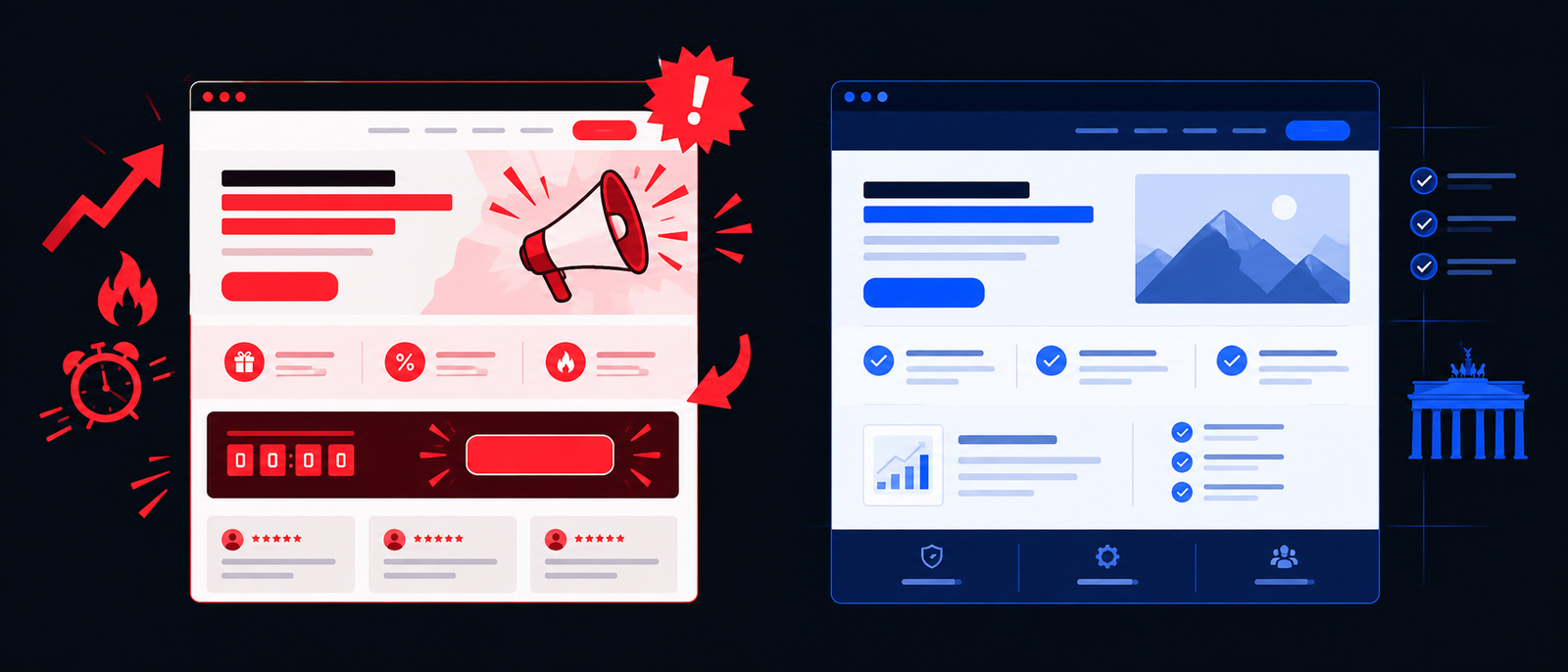
We started selling to German clients the way most agencies do — by translating what already worked elsewhere. Same page structure, same offer logic, same urgency mechanics, German words. It did not work. Not badly enough to be obvious in week one, but clearly enough by week six that we had to stop and rethink the whole approach.
What follows is what we actually changed. Some of it is cultural, some of it is legal, and some of it is simply that the German buyer is asking a different question than the Indian or Australian one.
The assumption that cost us
Our assumption was that a landing page is a landing page — that conversion psychology is universal and only the language changes. The specific thing that broke that assumption was the hero section.
On an Indian page for a service business, a hero that says "Book a free strategy call — limited slots this week" performs well. It creates a reason to act now. We ran the German equivalent and the bounce rate on the first screen was noticeably higher than on comparable pages in other markets.
When we asked a German client to read the page and tell us honestly what they thought, the answer was blunt: "It sounds like you are trying to rush me into something. What exactly do I get?"
That question — what exactly do I get — turned out to be the whole difference.
Indian and Australian pages often sell the outcome and fill in the detail later. German pages need to lead with the specification and let the outcome follow from it. Same information, opposite order.
Proof beats persuasion
The German pages that started working for us shared a pattern: they front-loaded concrete, checkable detail and dialled down the persuasive framing.
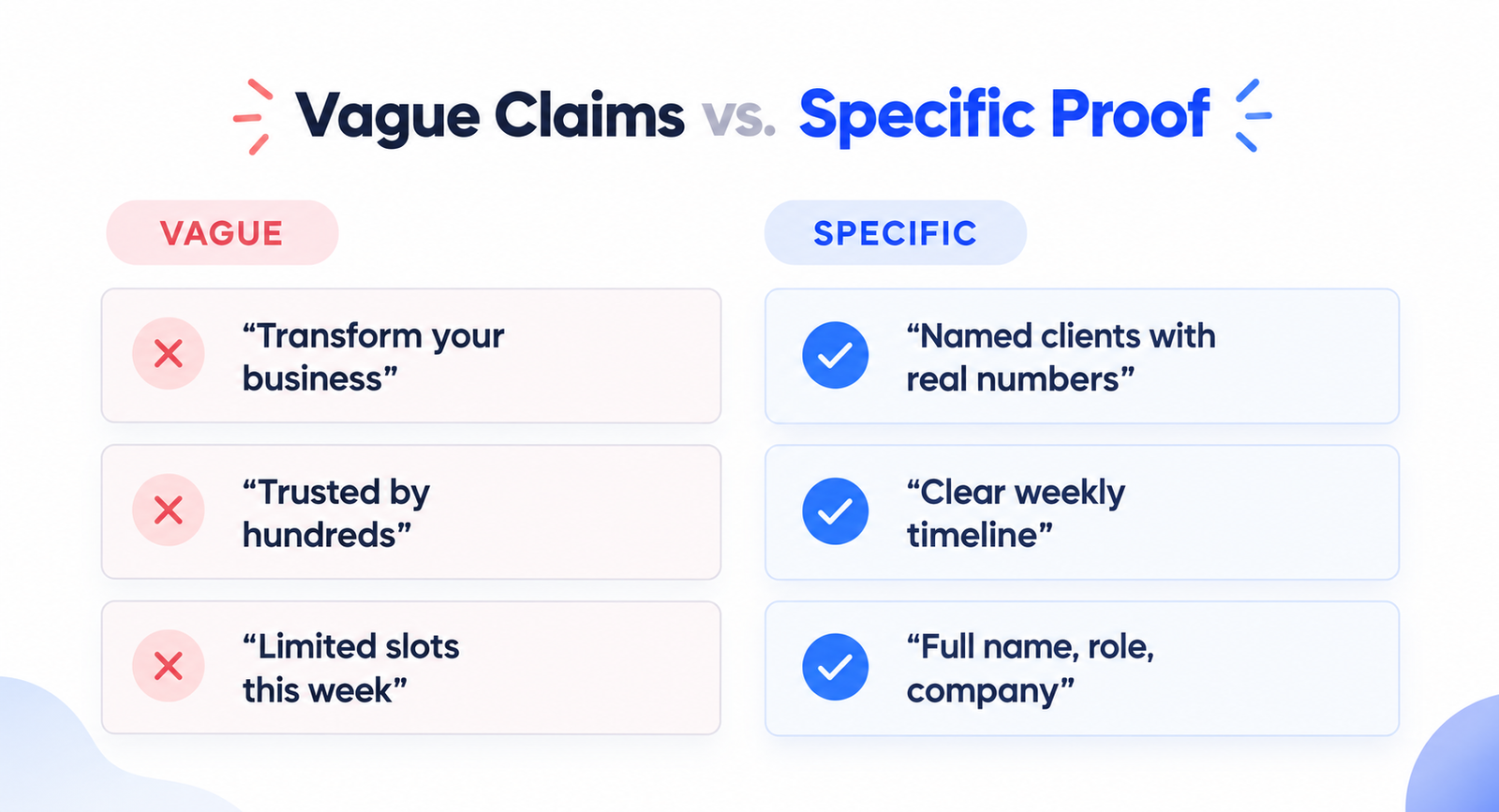
| What we removed | What replaced it |
|---|---|
| "Transform your business" | What the deliverable actually is, in a list |
| "Limited slots this week" | Realistic timeline: what happens in week 1, 2, 3 |
| "Trusted by hundreds" | Named clients, or a specific number with context |
| Testimonials as pull-quotes | Testimonials with full name, role and company |
| Price on request | A price, or at minimum an honest range |
| "Book a free consultation" | What the call covers and how long it takes |
The pattern is that every replacement is more specific and less flattering. A German buyer reading "trusted by hundreds of happy clients" does not feel reassured; they notice that no client has been named. The vagueness itself reads as a warning sign.
Anonymous testimonials are worth less than none
We had testimonials on a German page attributed as "M.K., Managing Director." In India that is normal and nobody blinks. The feedback we got was that it looked like we had written them ourselves. We replaced them with two full-name testimonials and removed the other four. Fewer, verifiable testimonials outperformed more, unverifiable ones.
Why hype backfires when selling to German clients
This is the hardest adjustment for anyone trained on Indian or American direct-response copy, because the instinct is to raise the emotional temperature when something is not converting. In Germany that instinct is exactly wrong.
Specific things that hurt us:
- Countdown timers. A visible timer on an evergreen offer reads as dishonest, because the buyer knows the offer is not really expiring. It damages trust rather than creating urgency.
- Crossed-out prices that were never charged. Beyond the credibility problem, price presentation is regulated in the EU, and inventing an anchor you never actually charged is a genuine legal risk, not just a taste issue.
- Exclamation marks and superlatives. "Best," "revolutionary," "game-changing" get discounted immediately. Claims without evidence attached read as noise.
- Over-promising in the guarantee. A guarantee with vague conditions is worse than no guarantee. If you offer one, the conditions need to be stated plainly and completely.
In India, enthusiasm signals confidence. In Germany, enthusiasm without specifics signals that you are hiding the specifics.
The pages you cannot skip
This part is not optional and it is not a design decision. Germany has specific requirements for commercial websites that most Indian agencies have never encountered.
We are not lawyers and this is not legal advice — anyone selling into Germany should get their setup reviewed by someone qualified in German law. But here is what we learned to plan for from the start rather than discover late:
Impressum
German law requires commercial websites to carry an Impressum — a legal notice page identifying who operates the site, with contact details and registration information. This obligation comes from the German Telemedia Act (Section 5, TMG), and it is expected to be reachable from every page, typically from the footer. German visitors look for it, and its absence is noticed. Missing or incomplete Impressum details are a known source of legal warnings in Germany.
Cookie consent that actually works
Under GDPR, non-essential tracking — which includes the Meta pixel and most analytics — needs consent before it fires, not after. A banner that says "we use cookies, OK?" while the pixel has already loaded does not meet the standard. The practical consequence for campaigns is significant: a meaningful share of visitors will decline, so your pixel data will be less complete than you are used to. Plan measurement around that rather than being surprised by it.
Privacy policy in German
An English privacy policy on a page targeting German buyers is a weak position both legally and commercially. It should be in German and it should describe what you actually do with data, not be copied from a generator.
Building a page for a European market?
We build with the consent and legal requirements planned in from the start, rather than bolting them on after the campaign is live. Tell us the market and we will tell you what changes.
Start a page project →The pace is different
The second structural difference we noticed while selling to German clients was timing. German buying cycles for services ran noticeably longer than what we were used to, and the reasons were consistent.
- More people are consulted. Even in small companies, decisions we would expect one founder to make alone were discussed internally first. That means your page has to persuade someone who is not on the call — which is another argument for written specifics over verbal charm.
- Written follow-up matters more. After a good call in India, a WhatsApp message often carries the deal forward. In Germany, a structured written proposal by email did more work than any call follow-up we tried.
- Fewer, better leads. Our German campaigns produced fewer enquiries than comparable Indian ones, but a higher share of them were serious. Judging German performance on lead volume made the campaigns look broken when they were not.
- Holidays are real. Long summer holidays and a genuinely quiet period around Christmas affect response rates. Campaign plans that ignore this misread the drop as a creative problem.
We stopped judging German campaigns on cost per lead and started judging them on cost per qualified conversation. The CPL looked poor next to our Indian accounts; the cost per real opportunity was competitive. We wrote more about why CPL alone misleads in our post on what a lead actually costs.
Language and register
Two things here, and the second matters more than the first.
Machine translation is visible
Modern translation is good enough that the meaning survives, but German readers spot translated marketing copy quickly — word order, idioms that do not exist in German, English sentence rhythm. On a page whose entire job is establishing credibility, copy that reads as foreign undercuts it. We now have German pages reviewed by a native speaker before they go live. It is not expensive and it is the highest-return check in the process.
Sie or du is a real decision
German distinguishes formal (Sie) and informal (du) address, and the choice sets the tone of the entire relationship. Business-to-business, professional services and anything involving significant money generally calls for Sie. Younger consumer brands and some startup-facing products use du deliberately. What does not work is mixing them on the same page, which happens easily when different sections are written at different times.
English has no equivalent decision, so it is easy to not realise a decision is being made. Make it explicitly, write it into the brief, and keep it consistent across the page, the ads and the follow-up emails.
Common questions
Can I run a German campaign with an English landing page?
For some technical B2B products aimed at international teams, sometimes. For local service businesses and most consumer offers, it substantially limits both reach and trust. If you are testing the market cheaply, an English page will tell you whether there is any interest at all — but do not read a weak result as proof the market is bad.
Are Meta ads worth running in Germany given the consent problem?
Yes, but with adjusted expectations. Because a share of visitors decline tracking, your pixel sees less than it does elsewhere and the algorithm has less to optimise on. Implementing the Conversions API helps recover server-side events. Expect learning phases to take longer and budget for that rather than killing campaigns early. Our post on retargeting covers the tracking setup in more detail.
Do I need a German company to sell there?
Not necessarily, but tax treatment, invoicing requirements and VAT handling differ depending on how you are set up and what you sell. This is squarely a question for an accountant familiar with cross-border EU services, not something to work out from blog posts.
How much longer should I expect the sales cycle to be?
In our experience it ran meaningfully longer than comparable Indian deals, but the variance was wide and it depends heavily on deal size and how many people are involved. The practical advice is to plan follow-up sequences that run for weeks rather than days, and not to treat a slow reply as disinterest.
What was the single biggest fix?
Replacing persuasion with specification in the first screen. Stating exactly what the deliverable is, what it costs and how long it takes, before making any argument about why it is good. Everything else was refinement around that one change.
Rohit Bhatt
Founder, LFC VenturesRohit builds landing pages and campaigns for clients in India, Australia and Germany, and spends a good part of his week selling to German clients directly. This post describes what his team changed in their own German work — it is not legal advice, and German legal requirements should be reviewed by a qualified professional.