AI automation
WhatsApp is where Indian buyers decide. Most businesses answer too late.
In India, WhatsApp isn't a messaging app — it's the operating system for buyer decisions. WhatsApp automation India is quickly becoming the difference between winning that decision and losing it. The problem is that most businesses treat WhatsApp like email: something you check when you get around to it. By then, the customer has already messaged your competitor.
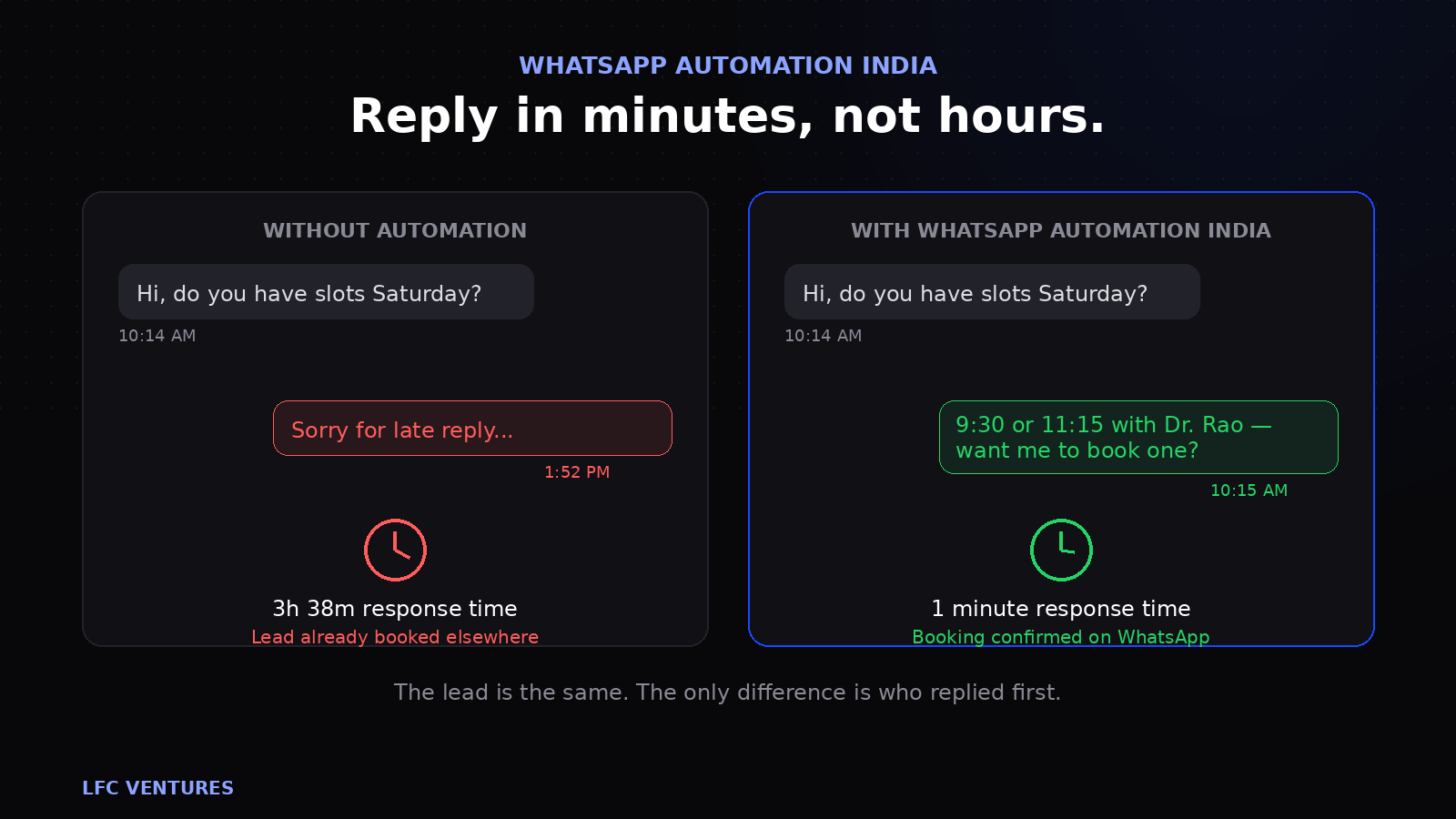
Here's a pattern we see in almost every Indian business we work with. A Meta ad runs. Someone clicks. They land on the page. Instead of filling in the form, they tap the WhatsApp button — because in India, that's what feels natural. The message lands. It sits unread for two hours, or four, or until morning. By the time someone replies, the customer has received a quote from the business that answered in three minutes.
The ad worked. The page worked. The WhatsApp button worked. The response time killed the sale. And this happens dozens of times a day in businesses spending ₹30,000 to ₹2,00,000 a month on ads — which means they're paying to generate enquiries they then lose to silence.
Why WhatsApp Automation India Is Different
This isn't opinion — it's numbers. WhatsApp has over 500 million monthly active users in India. It's the default communication channel for everything from family groups to business transactions. Understanding why matters, because it explains what buyers expect when they message you.
It's where trust lives
Indian buyers — especially for services, consultations and high-consideration purchases — prefer WhatsApp over forms because the conversation is personal, the history is visible, and the response feels human. Filling in a web form and waiting for an email reply feels corporate and uncertain. Sending a WhatsApp message and getting a reply feels like talking to a person. That feeling of personal connection is why WhatsApp enquiries convert at 2–3x the rate of form submissions in almost every Indian business we've measured.
It's where decisions happen
A buyer sends a WhatsApp message to three clinics, three tutors, or three agencies. The first one to reply with a useful answer — not "thanks for your message, we'll get back to you" but an actual answer to their question — wins the conversation. The others get left on read. This isn't a metaphor. We've watched it happen in screen recordings on client phones. The decision window is minutes, not hours.
It's where payment conversations happen
In India, the final "yes, I'll pay" often happens on WhatsApp, not on a checkout page. The buyer asks a last question, gets reassurance, and sends a UPI payment or confirms a booking. If your automation strategy doesn't account for this — if it ends at "enquiry received" — you're automating the easy part and leaving the revenue part to chance.
In India, WhatsApp isn't a channel. It's the channel. Any automation strategy that doesn't start here is solving the wrong problem first.
The speed problem
We measured response times across twenty-three Indian small businesses before implementing any automation. The results were consistent enough to be depressing:
| Time window | Average response time | What happens |
|---|---|---|
| Working hours (10am–7pm) | 47 minutes | Customer is still warm but has likely messaged a competitor |
| Evening (7pm–11pm) | 3–14 hours | Replied next morning to someone who decided last night |
| Night / early morning | 8–12 hours | Customer has booked elsewhere or forgotten |
| Weekends | 6–24 hours | The highest-intent buying window, the worst response time |
The cruelest irony: evenings and weekends are when Indian consumers have the most time to research and buy — they're off work, browsing Instagram, clicking ads, sending enquiries. And that's exactly when most businesses go dark.
Research across industries shows that responding within five minutes makes you 8x more likely to qualify the lead compared to responding within an hour. After thirty minutes, the probability of qualifying the lead drops by over 20x. These aren't marginal differences. This is the difference between a business that grows and one that spends money generating enquiries it never converts.
What WhatsApp Automation India Actually Looks Like
Most people hear "WhatsApp automation" and think of the auto-replies you get from large brands — those menu-driven bots that say "Press 1 for Sales, 2 for Support" and take nine steps to reach a human. That's not what we build, and it's not what works for Indian service businesses.
WhatsApp automation India, done right, means an AI agent that:
- Reads the message and understands what's being asked — not keyword matching, but genuine comprehension. "Do you have anything Saturday?" is a booking request, not a question about your schedule.
- Checks live data — your calendar, your pricing, your stock, your availability. The answer comes from your actual business systems, not from a script written three months ago.
- Replies in a way that sounds like your best staff member — warm, specific, and action-oriented. Not corporate, not robotic, not peppered with exclamation marks.
- Completes the task — books the appointment, sends the quote, confirms the order. The customer's next step is to show up, not to visit another page and fill in another form.
- Knows when to hand over — complaints, unusual requests, VIP customers and anything outside its rules go to a human with full conversation context. The customer doesn't repeat themselves.
A menu-driven bot says "Please select from the following options." An AI agent says "We have 9:30 or 11:15 on Saturday with Dr. Rao. Which works?" The first creates friction. The second eliminates it.
How to automate without sounding like a bot
The fear every business owner has is that automation will make them sound impersonal. Here's how to avoid that mistake when you're setting up WhatsApp automation India — and it's more about what you don't do than what you do.
Don't announce it's automated
You don't need to open with "Hi! I'm an AI assistant." Customers care about getting a good answer fast, not about who (or what) sent it. Be transparent if asked directly, but don't lead with it. Nobody introduces their receptionist by saying "this is a human answering your call."
Use natural language, not template language
Bad: "Thank you for your enquiry! We have received your message and a team member will respond shortly. In the meantime, please visit our website for more information."
Good: "Hi! For Saturday morning we have 9:30 or 11:15 available with Dr. Rao. Want me to book one of those?"
The first one sounds automated even when a human writes it. The second one sounds human even when an agent writes it. The difference is specificity and action. Generic acknowledgements sound like bots. Specific answers to specific questions sound like people.
Match the tone of the industry
A dental clinic's agent should be warm and reassuring. An airport transfer agent should be efficient and precise. A coaching business should be encouraging and direct. The tone comes from the system prompt we write during the build — it's configured once and applies to every conversation.
Use the customer's name
WhatsApp provides the contact's name. Using it naturally — "Hi Priya, we have two slots on Saturday" rather than "Hello, we have two slots" — is a small thing that makes a measurable difference in response rates. It costs nothing and signals attention.
Keep messages short
Indian WhatsApp conversations are short-message affairs. A reply longer than three sentences feels like a terms-and-conditions page. The agent should answer the question, offer the action, and stop. If more detail is needed, the customer will ask.
What should still reach a human
Automation isn't about replacing all human conversation. It's about replacing the repetitive part so humans can handle the part that matters. These should always route to a person:
- Complaints. An unhappy customer needs empathy and flexibility, not rules. The agent flags it, attaches the full conversation, and a human picks it up within minutes.
- Complex or unusual requests. "Can you do a pick-up in Goa for a wedding party of 14 with equipment?" is outside the agent's rules. It escalates with context.
- High-value negotiations. When someone is deciding between your ₹1,00,000 package and a competitor's, a human should close that conversation.
- Explicit requests for a human. "Can I speak to someone?" should always be honoured immediately. About 8–10% of customers ask this, and the number stays stable over time — meaning the other 90% are satisfied with the agent.
- Anything the agent isn't confident about. A well-built agent knows when it doesn't know. That boundary is defined during the build and is one of the most important design decisions.
The goal isn't zero human involvement. It's zero unnecessary human involvement. Every message the agent handles correctly is a message your team doesn't have to read, process and reply to — freeing them for the conversations that actually need them.
How to set it up
The path depends on your volume and your budget.
Under 20 enquiries per day: start simple
Use WhatsApp Business App (free) with quick replies and away messages. This isn't automation — it's templates. But it cuts response time from 47 minutes to under 5 for the most common questions. Set up 8–10 quick replies covering your top questions (pricing, availability, location, how-to-book) and use away messages outside working hours with a clear "we'll reply by [time]."
20–50 enquiries per day: structured automation
Use the WhatsApp Business API with a platform like WATI, Interakt or AiSensy. These let you build conversation flows, auto-assign to team members, and send template messages. It's a step up from quick replies but still rule-based — the flows are pre-written paths, not intelligent responses.
50+ enquiries per day, or complex pricing: AI agent
This is where WhatsApp automation India makes the economics work with a custom-built agent. The agent connects to WhatsApp Business API, reads messages, checks your live systems and completes tasks. The build takes three to six weeks and the ongoing cost is typically less than a single staff member's salary. We covered the full build process in our airport transfer case study.
Want to see what your enquiries would look like automated?
Send us your five most common WhatsApp questions. We'll show you exactly how WhatsApp automation India would handle each one — with your pricing, your tone, your rules.
Start an agent conversation →Common questions
Will WhatsApp ban my number for using automation?
Not if you use the official WhatsApp Business API. The API is Meta's own product, designed specifically for business automation. Bans happen when people use unofficial tools that violate WhatsApp's terms — mass-messaging personal numbers, scraping contacts, using modified app versions. The official API, accessed through approved partners (WATI, Interakt, Twilio), is safe and supported.
How much does WhatsApp automation India cost?
Meta charges per conversation, not per message. In India, a business-initiated conversation costs approximately ₹0.55–₹0.70 and a user-initiated conversation (they message you first) is free for the first 1,000 per month. After that, roughly ₹0.30–₹0.40 per conversation. The API platform (WATI, Interakt) charges ₹2,000–₹5,000/month depending on features. Total cost for a business handling 500 conversations/month: roughly ₹3,000–₹6,000/month before the agent build.
Can the agent handle voice notes?
Not yet with high reliability. Voice note transcription exists but accuracy in Indian English, Hindi and regional languages is still inconsistent enough that we don't recommend relying on it for business-critical conversations. The agent can acknowledge a voice note and ask the customer to type their request, which works well in practice — most people are willing to type a one-line summary.
What about Hindi and regional languages?
Modern AI agents handle Hindi, Hinglish and most major Indian languages well in text. The agent can detect the customer's language from their first message and respond in the same language. Accuracy is highest in Hindi and Hinglish, good in Tamil, Telugu and Bengali, and improving in others. We test with real messages in the customer's language before launch.
How long until it pays for itself?
For a business spending ₹50,000+/month on ads with a 47-minute average response time, the math usually works within 30–60 days. The agent doesn't generate more leads — it converts more of the leads you're already paying for. If you're losing 30% of enquiries to slow response (which is conservative), and the agent recovers half of that, the ROI is clear on the first month's ad spend alone.
Rohit Bhatt
Founder, LFC VenturesRohit builds WhatsApp automation India strategies — custom AI agents for Indian service businesses. The response time data in this post comes from pre-automation audits across 23 businesses his team worked with in 2025–2026.