Landing pages
When a video sales letter landing page helps, and when it just slows you down
A video sales letter landing page is the most overprescribed tool in conversion strategy. When it works, it doubles conversion rates. When it doesn't, it adds production cost, page weight and a barrier between the visitor and the action. Here's how to know which side you're on before you spend the money.
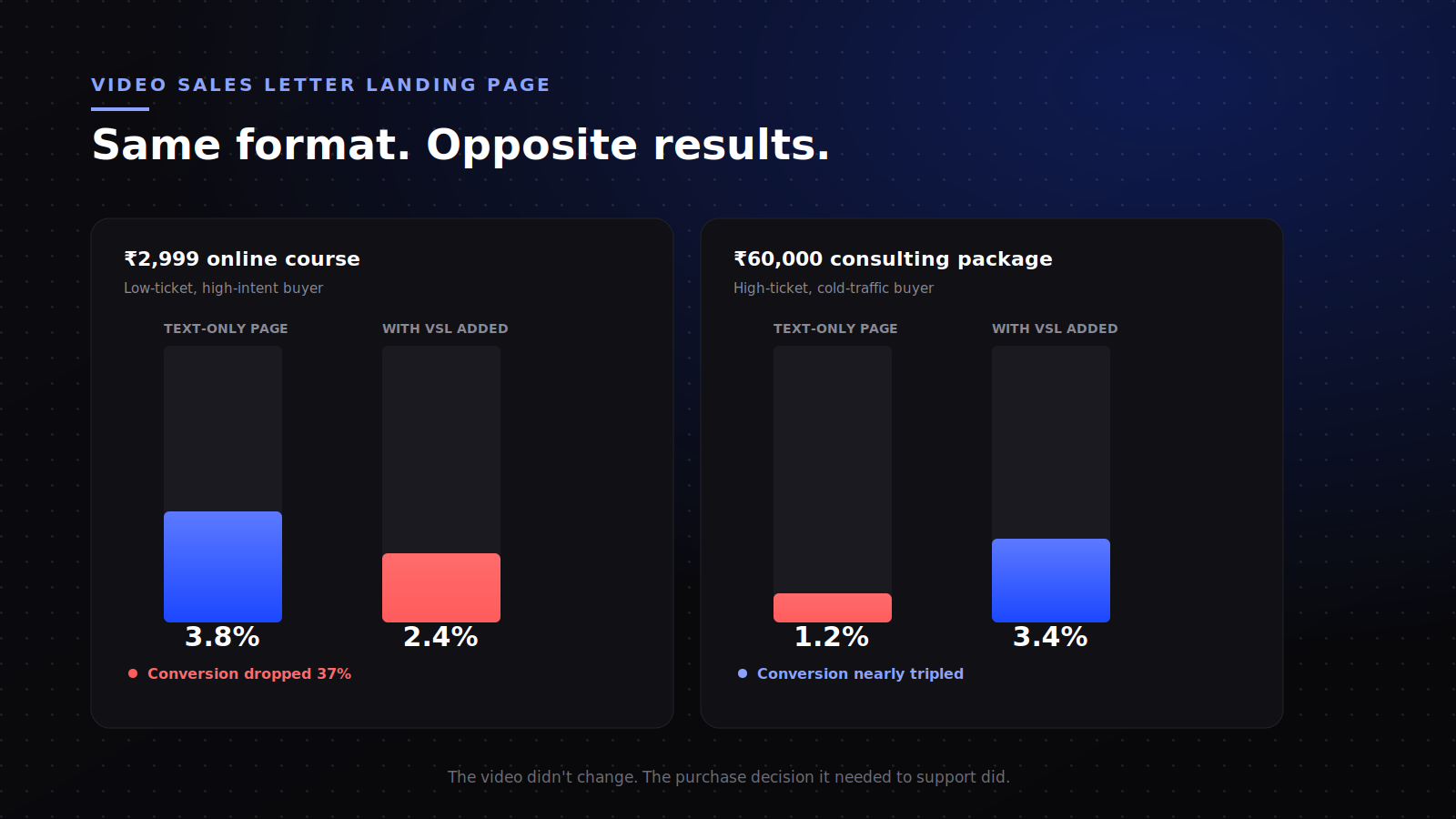
A coaching client came to us convinced they needed a VSL. They'd seen a competitor's funnel, watched the 12-minute video, and assumed that was the reason it was working. We scripted, shot and placed a VSL on their page. Conversion rate dropped from 3.8% to 2.4%.
Why? Their product was a ₹2,999 online course. The buyer didn't need 12 minutes of convincing. They needed a clear headline, three bullet points and a checkout button. The VSL created a wall between the visitor and the purchase — a wall made of time, bandwidth and patience — and most people bounced before finishing it.
Six months later, a different client — selling ₹60,000 consulting packages — asked us to test a VSL. Their text-only page converted at 1.2%. The VSL page converted at 3.4%. Same format, opposite results. The difference wasn't the video — it was the purchase decision the video needed to support.
This is the question every founder should ask before building a video sales letter landing page: does this purchase need more persuasion than a headline can carry, or does it just need a clear path to checkout?
What a VSL actually is
A video sales letter is not a product demo, a brand film or a talking-head testimonial. It's a scripted argument delivered in video format, designed to walk a viewer through the exact sequence of thoughts that leads to a buying decision.
The script follows a structure, usually some variation of:
- Hook — name the problem in a way that makes the viewer recognise themselves
- Agitation — describe the cost of leaving the problem unsolved
- Story — how you or someone like the viewer faced and solved this problem
- Mechanism — explain what makes your approach different (not better — different)
- Offer — what they get, what it costs, what happens next
- Proof — results, testimonials, numbers
- Close — the specific action, with the risk addressed
This structure works because it handles objections in sequence. Each section addresses the next reason someone might not buy. By the end, the viewer has either been convinced or has self-selected out — both of which are useful outcomes. Research on video usability from Nielsen Norman Group backs this up: structured, purposeful video consistently outperforms unstructured video for task completion.
When a video sales letter landing page works
A VSL earns its place on a landing page when the purchase decision requires more persuasion than a headline and bullet points can carry. Specifically:
High ticket price (above ₹15,000)
The higher the price, the more objections the buyer has, and the more time they need to feel confident. A ₹60,000 consulting package requires trust, credibility, proof and a detailed understanding of what happens after they pay. Text can do this, but video does it faster and with more emotional weight — because the buyer sees and hears a real person, which builds trust more efficiently than text.
Complex or unfamiliar service
If what you sell requires explanation — if the buyer doesn't yet understand what it is, not just whether they want it — video is the most efficient way to educate and persuade simultaneously. AI agents are a perfect example: most Indian business owners don't fully understand what an agent does versus a chatbot. A 5-minute VSL showing the real WhatsApp conversation from our airport transfer case study makes the concept tangible in a way that text struggles to match.
Personal or trust-dependent purchases
Coaching, consulting, therapy, personal training — services where the buyer is hiring a person, not a company. They want to hear the person speak. They want to assess competence, confidence and whether they'd actually want to spend time with this individual. A VSL with the founder or practitioner speaking directly to camera handles this in three minutes.
Cold traffic from paid ads
When the visitor has never heard of you, they have maximum scepticism and minimum context. A VSL provides both context and proof in a format that requires less effort from the viewer than reading 2,000 words. This is why VSL funnels are standard for Meta ads to cold audiences selling anything above ₹10,000.
If the buyer needs to trust a person, understand something new, or justify a price above ₹15,000 — a video sales letter landing page will likely help. If the buyer already knows what they want and the price is low — it will likely slow them down.
When a VSL hurts
A VSL hurts conversion when the decision is simpler than the format assumes. Specifically:
Low-price impulse purchases (under ₹5,000)
A ₹999 digital download, a ₹2,999 mini-course, a ₹499 product. The buyer doesn't need convincing — they need a clear description and a checkout button. A 10-minute video for a ₹999 purchase communicates "this product requires this much explanation, which probably means it's not very good." The time investment doesn't match the price investment.
High-intent search traffic
Someone who Googled "dentist near me Jaipur" and clicked your Google ad already knows they need a dentist. A VSL about the importance of dental health is wasting their time. They want to see if you have Saturday appointments, how much a cleaning costs, and how to book. Text, a price and a booking button will outperform any video.
Repeat or referral traffic
If the visitor was sent by a friend or has already read your blog posts, they have context and a degree of trust. The VSL repeats information they already have. A shorter page with a direct offer will convert better because it respects the context they arrived with.
When the page is already slow
A self-hosted video can add 3–10MB to page weight. On Indian mobile networks, that's 2–6 additional seconds of load time. If your page already takes 3 seconds to load, adding a video pushes it to 6+ seconds, and you lose more visitors to load time than you gain from the video content. Google's own Core Web Vitals guidance treats this load penalty as a direct ranking and UX cost — not just a nice-to-have. We covered the impact of load time in detail in our post on page speed and conversions.
The video sales letter landing page decision framework
Before spending money on a VSL, answer these four questions:
| Question | If yes | If no |
|---|---|---|
| Is the ticket price above ₹15,000? | VSL likely helps | Probably not worth it |
| Does the buyer need to understand something new? | VSL likely helps | Text is sufficient |
| Is the traffic cold (paid ads, no prior awareness)? | VSL likely helps | Shorter page works |
| Can the page load in under 3 seconds with the video? | Safe to add | Fix speed first |
If you answered "yes" to three or four of these, build a VSL on your landing page. If you answered "yes" to one or zero, invest the budget in better copy and a stronger offer instead — you'll get more return per rupee.
How to structure one that converts
A VSL is only as good as its script. The production quality matters far less than most people think. Here's the structure we use:
The first 15 seconds (the hook)
This is where 60–70% of viewers decide whether to keep watching. The hook must do one thing: make the viewer think "this is about me." Not about you, not about your company, not about the industry. Name their specific problem in their specific language.
Good: "If you're spending ₹50,000 a month on Meta ads and your phone isn't ringing, this is probably why."
Bad: "Hi, I'm Rohit from LFC Ventures, and today I want to talk about the importance of conversion optimisation."
Minutes 1–3 (the problem and story)
Describe the cost of leaving the problem unsolved. Then tell the story of how you or a client faced the same situation. Stories hold attention more reliably than arguments. The viewer should be thinking "that sounds exactly like what's happening to me."
Minutes 3–5 (the mechanism)
Explain what you do and why it's different — not better, different. "We build the page and the campaign together so the message never breaks in the middle" is a mechanism. "We provide best-in-class landing page solutions" is a category claim that nobody believes.
Minutes 5–7 (proof and offer)
Show results. Name clients or describe them specifically enough to be credible. Then state the offer: what they get, what it costs (or what the next step is), and what risk you're removing. End with a single, specific call to action.
Total length: 5–8 minutes. Anything over 10 minutes needs to be exceptionally good to hold attention. We've tested 15-minute VSLs against 7-minute versions and the shorter version wins in Indian markets almost every time — attention is shorter on mobile, and over 85% of your Meta traffic arrives on mobile.
A 7-minute VSL that 60% of viewers finish will outperform a 15-minute VSL that only 25% finish. Completion rate is conversion rate. Shorter wins.
Need the script written and the shoot directed?
We script, direct and integrate VSLs as part of our landing page builds. The script is included in the page project — you don't pay for video production separately.
Start a page project →Production without the production budget
Most Indian founders hear "VSL" and think "studio, crew, ₹2,00,000." That's a corporate brand film, not a video sales letter landing page. The most effective VSLs we've produced cost a fraction of that.
What you actually need
- A smartphone with a good front camera — the camera on a ₹30,000 phone shoots better video than a professional camera did ten years ago
- A ₹1,500 lavalier microphone — audio quality matters more than video quality. Bad audio is the single most common reason viewers stop watching. A Boya BY-M1 or equivalent is enough.
- Natural light or a ₹2,000 ring light — shoot facing a window during the day and the lighting is free
- A script — this is the expensive part, and it should be. The script is the strategy. Everything else is execution.
What you don't need
- A studio or backdrop — a clean wall or bookshelf works. Over-produced backgrounds actually reduce trust for founder-led businesses because they look corporate rather than personal.
- Professional editing — jump cuts, text overlays and a clean trim are enough. You're not making a documentary. A clean, slightly imperfect video from a real person converts better than a polished brand film.
- B-roll and animations — they add production time without adding conversion. Save them for YouTube content where watch time is the metric. On a VSL, the metric is action taken after watching.
Total cost of a DIY VSL setup: under ₹5,000. The script — which is the actual conversion tool — is where the investment belongs.
Common questions
Should the VSL autoplay?
No. Autoplay with sound is blocked by most browsers anyway, and autoplay without sound means the viewer sees a muted video they didn't ask for — which reads as spam. Let them click play. The click is a micro-commitment that increases the likelihood they'll watch through. Place a compelling thumbnail and a visible play button instead.
Where on the page should the VSL go?
Below the headline and above the fold on desktop. On mobile, place it after a short text introduction — because mobile viewers need to understand what the video is about before committing to watching it. Never hide it below the fold where people have to scroll to find it. If it's worth having, it's worth seeing early.
Should I use Wistia, YouTube or self-host?
Wistia or Vimeo for landing pages. YouTube embeds come with suggested videos at the end, which are exit links competing with your CTA. Self-hosting is the worst option — massive file sizes, no adaptive streaming, and no analytics. Wistia's free tier is enough for most landing pages and gives you heatmaps showing exactly where viewers drop off.
Can I use a screen recording instead of face-to-camera?
Yes, and it works well for SaaS, tools and anything where showing the product is more persuasive than showing a person. A "walkthrough VSL" — screen recording with a voiceover narrating the value — converts well for products under ₹25,000. Above that, the buyer usually wants to see the person they're hiring.
How do I know if my VSL is working?
Track three things: play rate (what percentage of page visitors click play), completion rate (what percentage finish the video), and post-view conversion rate (what percentage of viewers take the action). If play rate is low, your thumbnail and context text need work. If completion rate is low, the script is losing them — check where the drop-off is. If completion is high but conversion is low, the CTA after the video is the problem.
Rohit Bhatt
Founder, LFC VenturesRohit scripts and directs VSLs as part of LFC Ventures' landing page builds. The 3.8%-to-2.4% and 1.2%-to-3.4% results cited in this post are from real client projects.