Meta ads
Retargeting strategy for Meta ads that doesn't just follow people around
Good retargeting strategy meta ads campaigns use one thing badly-run ones don't: they move people forward instead of repeating the same ad to someone who already said no. That's not persuasion, it's repetition with a budget. Sequence it against where people actually dropped off, and the same spend produces a different result.
You visit a shoe website. You look at one pair. You leave. For the next three weeks, that exact pair of shoes follows you across Instagram, Facebook and every website with an ad slot. You didn't buy them the first time. You're not going to buy them the tenth time. But the budget keeps spending.
This is what most retargeting looks like, and it's why business owners often conclude that retargeting doesn't work. It works — but only when the ad acknowledges that the person has already seen your offer and didn't act, and addresses why they didn't act. That distinction is the entire difference between a retargeting strategy meta ads campaigns should run and the version most businesses actually run.
A retargeting strategy for Meta ads that actually performs starts from that acknowledgement, not from a single audience and a single repeated ad.
Why most retargeting fails
The failure is structural, not tactical. Most retargeting campaigns are built on one audience ("everyone who visited my website in the last 30 days") receiving one message (the same ad that didn't convert them the first time).
That approach ignores three things:
- Different people left for different reasons. Someone who bounced in four seconds has a completely different objection from someone who read the whole page, opened the form, and abandoned it. Treating them identically means the message is wrong for at least one of them, and usually both.
- Repetition creates resentment, not persuasion. After roughly 4–6 exposures to the same creative, ad fatigue sets in. Click-through rate drops, cost per click rises, and the brand association shifts from "interesting" to "annoying." You're paying to damage your own brand.
- The objection is never addressed. If someone didn't convert because they weren't sure about price, showing them the same ad doesn't answer the price question. It just asks again. And again.
Retargeting isn't a second chance to show the same ad. It's a chance to answer the question that stopped them the first time.
Meta's own guidance on custom audience setup confirms this is a segmentation problem, not a budget problem — the platform is built to let advertisers slice audiences by exactly the behaviours that matter, most people just don't use it.
Segment by drop-off point
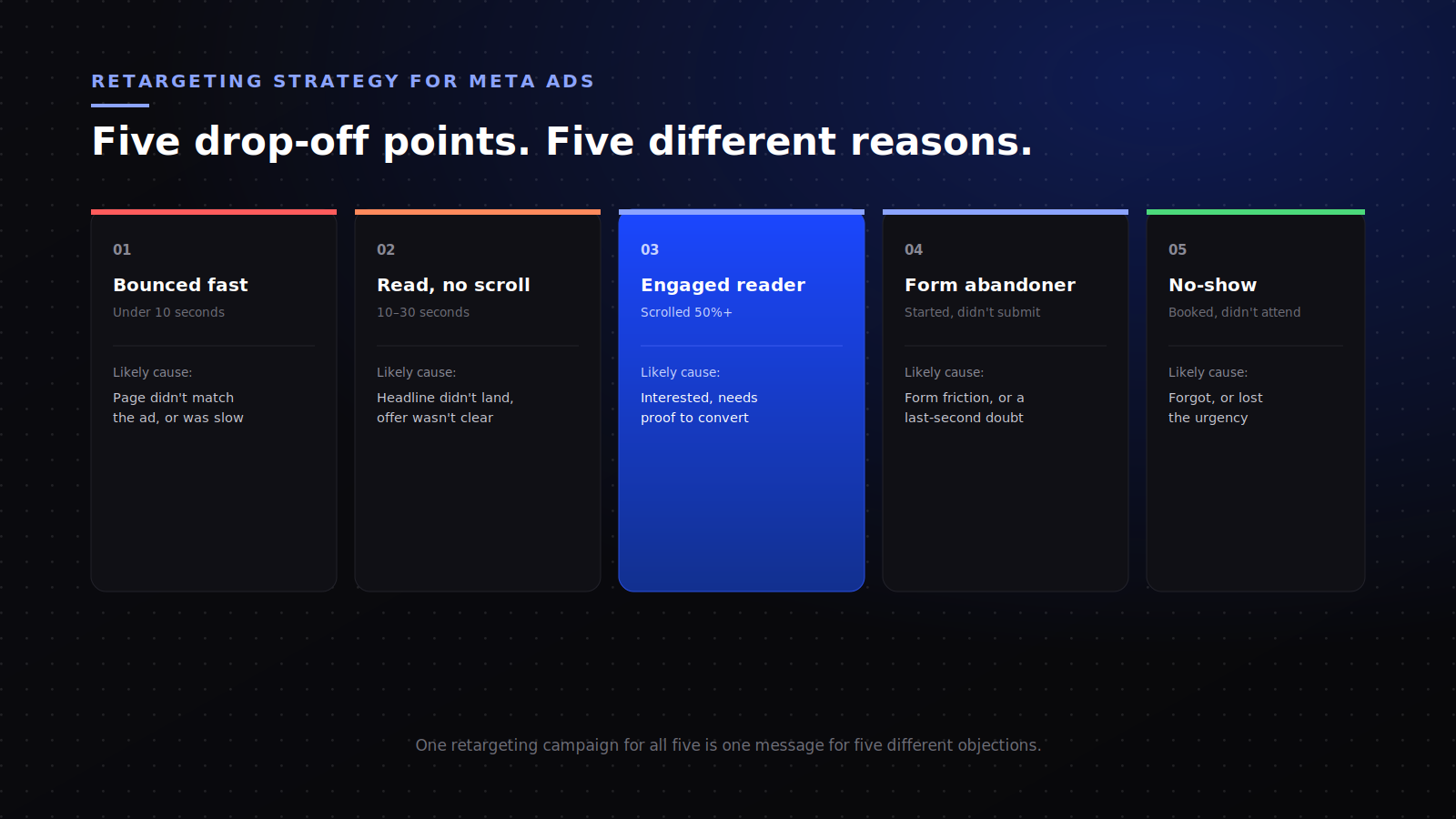
The foundation of any working retargeting strategy meta ads campaign should follow is segmenting by how far someone got, because how far they got tells you what stopped them. Here are the five segments we build for most clients:
| Segment | What they did | What likely stopped them |
|---|---|---|
| Bounced fast | Under 10 seconds on page | Page didn't match the ad, or loaded slowly |
| Read but didn't scroll | 10–30 seconds, no scroll past hero | Headline didn't land, offer wasn't clear |
| Engaged readers | Scrolled 50%+, 30+ seconds | Interested but not convinced — needs proof |
| Form abandoners | Started the form, didn't submit | Form friction, or a last-second doubt |
| Converted but no-show | Booked but didn't attend | Forgot, or lost the urgency |
Each of these is a genuinely different person with a genuinely different objection. Building one retargeting campaign for all five is like giving the same medicine to five patients with five different illnesses.
If your traffic volume is small (under 2,000 visitors/month), you won't have enough people in each segment to run five campaigns effectively. Start with two: "engaged but didn't convert" and "form abandoners." These two carry the most value and are large enough to be actionable at most budget levels.
What to say to each segment
Here's how the message changes for each drop-off point. Note that the creative changes, not just the copy — different objections need different formats.
Bounced fast (under 10 seconds)
The objection: "This isn't what I clicked for" or "this page is taking too long."
The message: Restate the offer in the clearest possible terms, with no ambiguity. Use a different creative than the original — if the first was a video, use a static image with text. Send them to a faster, simpler version of the page if possible.
Honest note: This is the hardest segment to recover. Many of these people were never a fit. Don't over-invest here — cap the budget and move on.
Read but didn't scroll
The objection: "I don't understand what this is" or "this doesn't seem to be for me."
The message: Lead with a different angle than your original headline. If the first ad was outcome-led, try pain-led. If it was pain-led, try proof-led. This is essentially a second headline test, delivered through retargeting. We cover the three angles in our post on headline testing.
Engaged readers (scrolled 50%+)
The objection: "I'm interested but I'm not sure this works for someone like me."
The message: Proof. This is where case studies, testimonials and specific results belong. A short video testimonial from a client in the same industry is the single highest-performing retargeting creative for this segment. "Here's what happened for a clinic in Pune" answers the question they're actually asking.
Form abandoners
The objection: "I got nervous" or "the form asked for too much" or "I got distracted."
The message: Reduce the perceived commitment and remove the risk. "It takes 30 seconds and you're not committing to anything." "No credit card, no sales call unless you want one." If your form is long, offer a shorter path — a WhatsApp message instead of a form, for instance. In India especially, offering WhatsApp as the alternative recovers a meaningful share of form abandoners.
Converted but no-show
The objection: "I forgot" or "it stopped feeling urgent."
The message: Reminder plus reinforcement of what they'll get. This segment is usually better handled by WhatsApp or SMS than by ads, but a light ad presence keeps the brand top-of-mind before the appointment.
Time windows that matter
Retargeting windows should match your buying cycle, not a default setting. Most accounts we audit use 30 days for everything, which is wrong for almost every business.
| Business type | Window | Why |
|---|---|---|
| D2C, impulse purchases | 3–7 days | Interest decays fast; after a week they've forgotten |
| Local services (clinics, salons) | 7–14 days | Need arises, gets solved quickly one way or another |
| Coaching, courses | 14–30 days | Considered purchase with a research phase |
| B2B, high-ticket services | 30–90 days | Multiple stakeholders, longer approval cycles |
| Real estate | 60–180 days | Largest purchase most people make; slow by nature |
Beyond your window, exclude them. Someone who visited your D2C page 45 days ago and never came back is not going to convert now — but they're still costing you budget if they're in a 90-day audience.
Building your retargeting strategy meta ads setup
The technical setup is straightforward once the strategy is clear. Here's the sequence:
- Verify your pixel and Conversions API are both firing. With iOS restrictions, pixel-only tracking loses a significant share of events. The Conversions API (server-side) recovers most of that. If you only have the pixel, your audiences are smaller than they should be and your retargeting reach suffers accordingly.
- Create custom audiences by engagement depth. In Meta Events Manager, build audiences based on: all page visitors, time on page (using a custom event), scroll depth (requires a custom event or Google Tag Manager), form starts (ViewContent or a custom event), and conversions.
- Build exclusions properly. Every retargeting audience must exclude people who converted. This sounds obvious but we find it broken in roughly half the accounts we audit — businesses paying to retarget customers who already bought.
- Set frequency caps. In the ad set settings, cap impressions at roughly 3–4 per week per person. Beyond that, you're generating fatigue rather than persuasion.
- Rotate creative every 2–3 weeks. Retargeting audiences are small, which means each person sees your ad more often than in cold campaigns. Fatigue arrives faster. Plan for creative rotation from the start rather than treating it as an emergency response.
Want us to audit your retargeting setup?
We'll check your audiences, exclusions, windows and creative rotation — and tell you exactly where the budget is leaking.
Get a campaign review →Mistakes that waste budget
These are the errors we find most often when auditing Indian ad accounts:
- Not excluding converters. The most expensive mistake and the most common. You're paying to advertise to people who already bought. Check this first in your own account — it takes two minutes.
- Retargeting window too long. A 180-day window for a ₹1,500 D2C product means you're paying to reach people who forgot your brand five months ago.
- Same creative for 90 days. Retargeting audiences are small and see ads frequently. What feels like "we just launched this" to you is the fortieth impression for the viewer.
- Retargeting before you have volume. If your cold campaigns generate 200 visitors a month, splitting that into five retargeting segments gives you audiences of 40 people. Meta can't optimise at that scale. Build traffic volume first, then segment.
- Discounting immediately. Leading your retargeting with a discount teaches your audience to wait for the discount. Save price incentives for the last stage of the sequence, if you use them at all — and consider whether adding proof would work better than cutting margin.
- No sequence, just repetition. The whole point of a retargeting strategy meta ads campaigns run on is progression: awareness → interest → proof → objection handling → close. If every ad in your retargeting campaign says the same thing, there's no sequence, just frequency.
Common questions
How much of my budget should go to retargeting?
Typically 15–25% for most businesses. Retargeting audiences are small, so they can't absorb much budget before frequency becomes excessive. If you're spending 50% of budget on retargeting, you're almost certainly over-serving a small audience. The exception is e-commerce with high traffic volume, where retargeting can justifiably take 30–40%.
Does retargeting still work after iOS privacy changes?
Yes, but audiences are smaller than they were before 2021. The fix is implementing the Conversions API alongside the pixel, which recovers a substantial portion of lost events through server-side tracking. Meta's Conversions API documentation covers the setup in detail. Without CAPI, your retargeting audiences may be 30–50% smaller than they should be. This is the single most impactful technical fix available to most Indian advertisers.
Should I retarget across Google and Meta simultaneously?
Only if you have the volume to support both. Splitting a small audience across two platforms means neither has enough data to optimise. Start with the platform where your cold traffic performs best, get the sequence working there, and expand once you have consistent volume. Most Indian businesses under ₹1,00,000/month total spend should focus on one platform.
How long before I judge whether retargeting is working?
Give it at least 30 days and enough spend to generate 30–50 conversions across the retargeting campaigns. Retargeting typically shows a lower cost per acquisition than cold traffic — if yours is higher, something is structurally wrong (usually missing exclusions or a window that's too long).
Can I retarget people who engaged with my Instagram but never visited my site?
Yes, and it's underused. Meta lets you build audiences from Instagram profile visits, post engagement, video views and saved posts. These people have shown interest without ever reaching your page, which makes them a warmer audience than cold targeting but colder than site visitors. Treat them as a mid-funnel segment — introduce the offer rather than assuming they've seen it.
Rohit Bhatt
Founder, LFC VenturesRohit runs Meta campaigns alongside the landing pages they point at. The segment framework in this post is the structure his team builds into client accounts.