AI automation
Voice agents are quietly replacing the missed call
Every unanswered call is a booking your competitor takes. AI voice agent missed calls are more common than most owners realise, and the loss never shows up as a complaint — it shows up as a number that never called back. Here's what it actually costs, what a voice agent fixes, and what callers themselves think about talking to one.
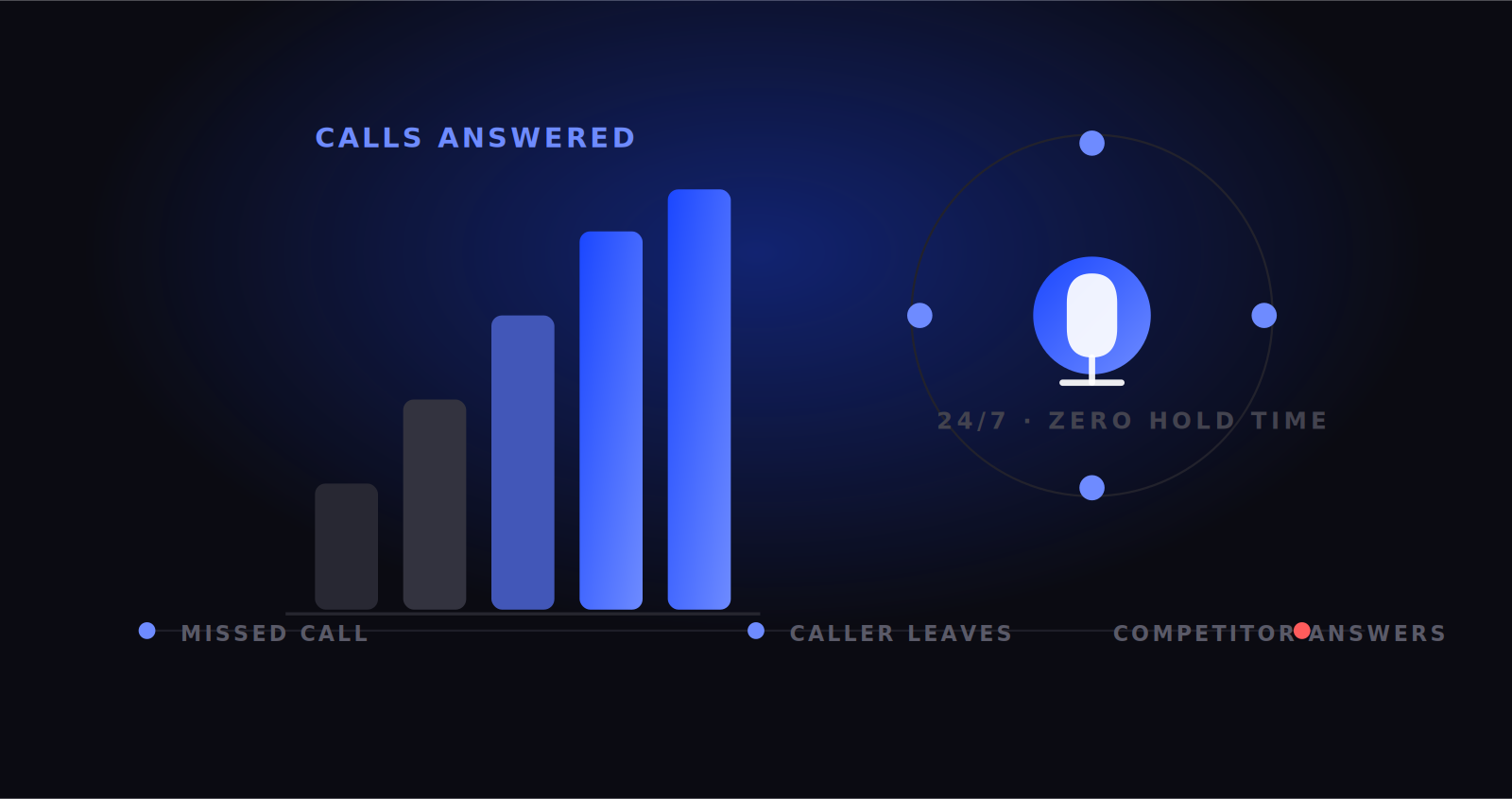
A patient calls a clinic at 7:40pm to book an appointment. The reception desk closed at 7. The call rings six times and goes to a generic voicemail that nobody checks until the next morning. By then, the patient has called two other clinics and already has an appointment with one of them.
Nothing about this shows up in your reports. There's no error message, no lost-deal notification, no line item that says "revenue lost to unanswered phone." It just quietly doesn't happen. The call log shows a missed call with no name attached, and the business moves on with its day — which is exactly how AI voice agent missed calls stay invisible until someone actually runs the numbers.
What AI voice agent missed calls actually cost your business
We ran this number for a handful of clients across clinics, salons and home-service businesses before writing this post, because the honest answer is that most owners have never measured it. Independent research on missed call statistics backs up what we see in client data: this is a bigger leak than most owners assume.
| Business type | Typical missed-call rate | Rough value per lost call |
|---|---|---|
| Dental / medical clinic | 18–30% of inbound calls | ₹3,000–15,000 per patient lifetime |
| Salon / spa | 25–35% of inbound calls | ₹800–3,000 per booking |
| Home services (AC, plumbing, pest) | 20–40% of inbound calls | ₹1,500–8,000 per job |
| Real estate / property | 15–25% of inbound calls | Commission-scale, often lakhs |
Multiply even the low end of that missed-call rate by your average call volume, and most businesses are sitting on a five- or six-figure monthly leak that never appears on a P&L line because it was never a booking to begin with — it was a booking that almost happened.
You don't lose a missed call. You lose the customer, permanently, to whichever competitor picked up first.
Why calls get missed in the first place
It's rarely negligence. It's almost always structural:
- After-hours calls. Most small businesses operate on a 10–12 hour window, but customers search and call whenever the need occurs to them — often evenings and weekends.
- Front desk is already on another call. One receptionist can handle one call at a time. A second inbound call during a busy hour goes straight to a ring-out.
- Lunch, breaks, staff shortage. A single person covering the phone means every bathroom break is a window where calls go unanswered.
- High call volume from ads. Running paid ads that drive calls (common for clinics and home services) means volume spikes exactly when your team is least prepared for it.
None of this is a staffing failure you can fully fix by hiring more people — the economics rarely work for a small business to staff phones 24/7. That gap is exactly what voice agents were built to close, and it's why AI voice agent missed calls have become such a common problem for clinics and service businesses that can't staff phones round the clock.
What a voice agent actually does
A voice agent is an AI system that answers your business phone line, holds a real spoken conversation with the caller, and either resolves the call or books it — without a human involved. It is not a phone tree ("press 1 for billing"), and it isn't reading from a fixed script. It understands what the caller is asking and responds in natural speech.
In practice, a well-built voice agent for a service business handles:
- Answering every call instantly, at any hour. No rings, no hold music, no voicemail. The call is picked up in under a second, every time.
- Understanding the request. "I need to get my AC serviced, it's not cooling" is understood as a service request, not just matched against keywords.
- Booking directly into your calendar. The agent checks real availability and books the slot, the same way a competent front-desk person would.
- Answering common questions. Pricing ranges, service areas, what to bring, cancellation policy — the questions that make up 80% of your call volume.
- Escalating what it can't handle. A complex complaint or an angry caller gets routed to a human, with the transcript already prepared for context.
A voice agent isn't meant to replace your front desk entirely for every conversation. It's built to catch the calls your team physically cannot — after hours, during peak volume, on days someone's off sick — and to hand off anything genuinely complicated to a person.
What callers think about talking to one
This is the objection we hear most often before a client tries it: "won't people hate talking to a robot?" The honest answer, based on what we've seen across live deployments, is more nuanced than yes or no.
Callers care about two things: getting their question answered, and not wasting time. A voice agent that answers instantly and books the slot correctly tends to score well on both, even when the caller clearly knows it's not a human. What breaks the experience isn't the fact that it's AI — it's when the agent misunderstands the request, loops, or can't hand off to a human when needed. The quality of the build matters more than the concept.
Where we see genuine resistance is with older callers and with emotionally loaded calls — a patient describing a health concern, for instance, often wants a human on the line regardless of how good the agent is. This is exactly why the escalation path in the setup matters as much as the automation itself.
Who this is a fit for
Voice agents pay for themselves fastest in businesses where three conditions are true together: call volume is meaningful (dozens of calls a day, not two or three), a real share of calls happen outside working hours or during busy periods, and each booked call has clear value — a service visit, an appointment, a lead worth following up. These are the businesses where AI voice agent missed calls translate directly into a measurable, recoverable number.
Businesses where this tends to work well: clinics and diagnostic centres, salons and spas, home services (AC repair, pest control, plumbing, electricians), gyms and fitness studios, and small hospitality operators. It's a weaker fit for businesses where every call is genuinely unique and high-context — complex B2B sales conversations, for instance, where a human's judgment in the moment is the actual value being delivered.
Curious what this would look like for your calls?
We'll listen to a sample of your actual call recordings and tell you honestly whether a voice agent would help — and roughly what it would recover.
Get a free call audit →What setup actually looks like
Deploying a voice agent isn't a plug-and-play toggle, but it's also not a months-long project for most small businesses fixing AI voice agent missed calls. Here's the realistic sequence:
- Call audit. We listen to a sample of your existing calls to understand the real range of what people ask — not the assumed range, the actual one.
- Script and knowledge base. We build out what the agent knows: pricing, services, availability rules, FAQs, and exactly where it should stop and escalate.
- Calendar and CRM connection. The agent needs to see real availability and write real bookings, so it connects directly into whatever you already use.
- Testing with real call patterns. Before it goes live, we run it against recordings of real past calls to catch misunderstandings before a real customer does.
- Soft launch with monitoring. The agent goes live alongside your existing team for the first few weeks, with every call reviewable, so we can tune it before scaling reliance on it.
Most straightforward deployments for a single-location business are live within two to three weeks. Multi-location or multi-service businesses take longer because the knowledge base is larger.
Common questions
Will callers know it's not a human?
Often, yes — and that's fine in most contexts, as long as the call is resolved quickly and correctly. We don't recommend trying to disguise it; a brief, natural disclosure at the start of the call sets expectations and avoids confusion later in the conversation.
What happens if the agent doesn't understand something?
It escalates to a human, with the conversation transcript attached so the person picking up isn't starting cold. The threshold for escalation is something we tune during setup based on your specific business — more cautious for complaint-heavy lines, less cautious for straightforward booking lines.
Does it work with Indian accents and regional languages?
Yes for most major Indian English accents and several regional languages, though accuracy varies by language and by how much background noise is typical on your calls. We test this specifically during the call audit stage before recommending a deployment.
How is this different from an IVR or phone tree?
An IVR forces the caller into a fixed menu ("press 1, press 2"). A voice agent has an open conversation and understands free-form speech, the way a person would. Most callers find IVRs frustrating precisely because they're rigid — a voice agent is built to avoid that specific failure.
What does it cost compared to hiring another front-desk person?
Meaningfully less than a full-time hire in most cases, and it covers hours a single hire physically can't — nights, weekends, simultaneous calls. It's best thought of as a supplement to your existing team for the calls they're structurally unable to catch, not a straight replacement.
Rohit Bhatt
Founder, LFC VenturesRohit leads the automation builds at LFC, including the voice and WhatsApp agents deployed across clinics and service businesses referenced in this post.