Landing pages
Landing page vs website — which one does your business need?
Landing page vs website: they solve different problems, cost different amounts, and work at different stages of your business. Confusing the two is the most common ₹50,000 mistake we see founders make. This is how to decide.
At least once a week, a founder contacts us asking to "redesign their website" when the actual problem is that their Meta ads are sending traffic to a homepage that was never built to convert strangers.
And at least once a week, someone else asks for a landing page when what they really need is a website — because they have no online presence at all and a single page can't carry the weight of explaining their entire business. This confusion is exactly why landing page vs website is one of the first questions we walk through with every new client.
The landing page vs website question isn't about which one is "better." They're different tools for different jobs, and choosing the wrong one costs you either money or time, usually both.
Landing page vs website: two different jobs
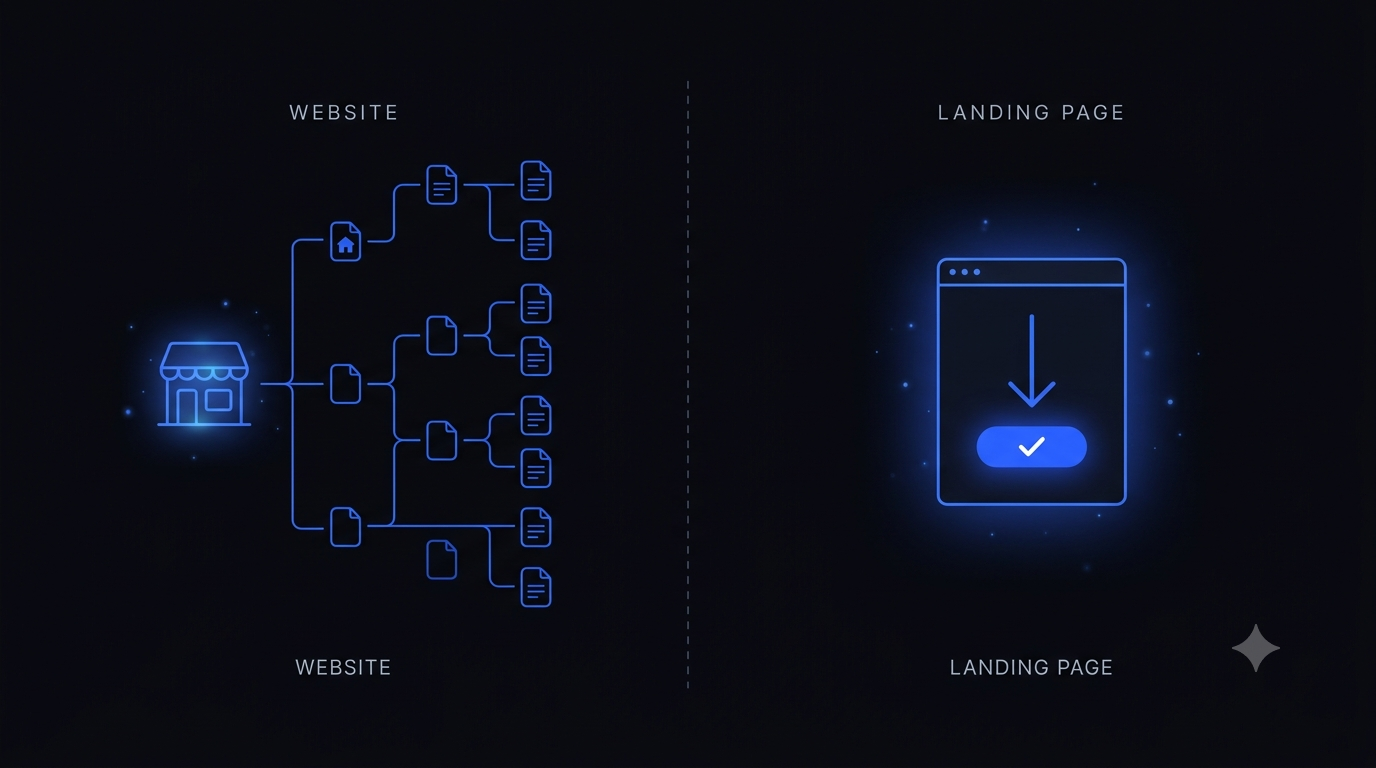
A website is your digital headquarters. It explains who you are, what you do, why you're credible, and how to reach you. It serves multiple audiences — existing customers, potential hires, partners, press, and prospects at various stages of interest. A good website answers the question "tell me about your company" from any direction someone might arrive.
A landing page is a conversion tool. It takes traffic from one specific source — an ad, an email, a social post — and moves those people toward one specific action: book a call, download a guide, buy a product, submit an enquiry. A good landing page answers the question "should I do this specific thing right now" and nothing else.
The website is a building. The landing page is a sales counter inside it. In the landing page vs website debate, they're not interchangeable — and not competitors either.
Side-by-side comparison
| Attribute | Website | Landing page |
|---|---|---|
| Primary job | Explain your business | Convert one audience to one action |
| Number of pages | 5–50+ | 1 |
| Navigation | Full menu, multiple paths | None or minimal — one path only |
| Audience | Everyone — clients, partners, hires | One segment from one traffic source |
| Traffic source | Organic search, referrals, direct | Paid ads, email, specific campaigns |
| Calls to action | Multiple — contact, learn more, careers | One — repeated throughout |
| Lifespan | Years, updated regularly | Weeks to months, tied to a campaign |
| SEO value | High — ranks for many terms over time | Low — usually not indexed intentionally |
| Cost in India | ₹30,000 – ₹3,00,000+ | ₹5,000 – ₹1,50,000 |
| Time to build | 3–12 weeks | 1–3 weeks |
This table alone answers most of the landing page vs website question for a given business — the row that describes your current bottleneck usually tells you which one to build next.
When you need a website
You need a website when at least two of the following are true:
- People Google your company name and find nothing, or find something outdated. This is credibility damage. When a prospect receives your proposal and searches your brand, the absence of a website raises the same red flag as a physical store with no signboard.
- You sell more than one thing. A coaching business that offers courses, group sessions, one-on-one consulting and corporate workshops can't squeeze all of that into a single page without overwhelming visitors. Each offering needs its own space.
- You need to rank in search. A website with ten well-written pages builds topical authority over time. A landing page is a single URL that rarely ranks for anything competitive. If organic traffic is part of your strategy, you need the website.
- You have multiple audience types. Customers, potential partners, investors and job candidates all need different information. A landing page can only speak to one of them.
- Trust takes time in your industry. In aviation, construction, enterprise software and professional services, buyers spend weeks evaluating before they reach out. A website with case studies, team bios, detailed service pages and a blog gives them enough material to build conviction on their own schedule.
When you need a landing page
You need a landing page when at least two of the following are true:
- You're running paid ads. This is the clearest signal. Sending ad traffic to a homepage is measurably worse than sending it to a dedicated landing page — because the homepage has navigation, competing links, and messages for different audiences. Google's own landing page quality guidelines make this exact point: the ad promised something specific, and the page needs to deliver on that promise without distraction.
- You need to test an offer. Before investing in a full website, a single landing page with a clear offer and ₹10,000 of ad spend will tell you within a week whether anyone wants what you're selling. This is the cheapest way to validate a business idea.
- You have one conversion action that matters right now. Book a demo. Download the checklist. Buy the starter pack. Schedule a consultation. If the business goal this quarter is one specific action, a landing page focuses every visitor on exactly that.
- Your website converts poorly and you can't rebuild it yet. A landing page sits alongside your website on a subdomain or subfolder and receives your campaign traffic while the main site continues serving everyone else. This is often the fastest path to better results while a website redesign is being planned.
- You're launching something with a deadline. A product launch, an event, a limited offer. These have end dates and specific audiences. A page built for the launch, optimised for the campaign, and taken down afterwards is the right tool. Bolting a temporary campaign onto a permanent website usually looks awkward and performs worse.
Ask yourself: "Am I paying to send specific people to this page?" If yes, you need a landing page. If people will find this page on their own through search, referrals and word of mouth, you need a website. If both — you need both.
When you need both
Most businesses we work with end up needing both a landing page and a website, and that's correct. Framing this as landing page vs website is a false choice for anyone running ads while also building a brand — the website handles organic discovery, brand credibility and the full story, while landing pages handle paid campaigns, launches and specific offers. They're not competing — they're doing different work.
A common setup we build:
- Main website at
yourbrand.com— homepage, about, services, work, blog, contact - Campaign landing pages at
yourbrand.com/offer-name/orlp.yourbrand.com— one per campaign, with no navigation, focused on a single action
The website links to the landing pages through blog CTAs and banner sections. The landing pages don't link back to the website — intentionally, because every link away from the page is an exit.
The visitor sees the landing page, takes the action, and enters your pipeline. If they want to learn more about your company first, they Google you and find the website. The two assets support each other without competing.
The best setup we see: a website that makes people trust you, and landing pages that make people act. They do different jobs, and neither one does the other's job well.
The expensive mistake
The most common version of this landing page vs website mistake in India goes like this:
A founder spends ₹50,000 on a beautiful five-page website. Then they start running Meta ads and point the traffic to the homepage. The homepage has a header menu with six links, a hero section that speaks to three different audiences, a services section, a team section, and a footer with twelve more links.
The visitor from the ad — who clicked because the ad promised a specific thing — arrives and sees a page that talks about everything except the specific thing they clicked for. They leave. The founder concludes that Meta ads don't work.
The ads were fine. The page was wrong. Not bad — wrong. The homepage was doing its job of explaining the company. It wasn't built to convert ad traffic. A ₹15,000 landing page with no navigation, one message matching the ad, and one form would have outperformed the ₹50,000 homepage.
The reverse mistake is rarer but just as costly: building a single landing page and treating it as your entire online presence. When a potential client searches your company name and finds a one-page sales pitch with no about section, no case studies and no credibility markers, you look like a fly-by-night operation even if you're not one.
Not sure which one you need first?
Tell us what you're selling and how people find you. We'll tell you whether the landing page vs website question resolves to a website, a landing page, or both for your business — and in what order.
Get an honest recommendation →Common questions
Can I use my homepage as a landing page?
You can, but it will almost always convert worse than a dedicated page. Homepages have navigation, multiple messages and multiple audiences. Landing pages have one message and one action. The homepage splits attention; the landing page focuses it. If budget is tight, a landing page with ₹15,000 of ad traffic will tell you more than a homepage with ₹50,000 of ad traffic.
Should my landing page be on my main domain?
Yes, ideally as a subfolder: yourbrand.com/offer-name/. This inherits whatever domain authority your main site has. A subdomain (lp.yourbrand.com) works too but is treated by Google as a somewhat separate property. Never put it on a completely different domain — you lose all trust signals and it looks suspicious to visitors.
Do landing pages hurt my SEO?
No, if handled correctly. Most campaign landing pages should be set to noindex so they don't compete with your website's pages in search. They're built for paid traffic, not organic. Your blog and service pages handle SEO. Your landing pages handle campaigns. They stay in their lanes.
I just started a business. Which should I build first?
If you're testing an idea with ads — build a landing page first. It's faster and cheaper, and it tells you whether the offer works before you invest in a full website. If you're building a brand for the long term and traffic will come from search, referrals and word of mouth — build the website first, then add landing pages when you start running campaigns. We break down what each costs in our post on landing page pricing in India.
How many landing pages do I need?
One per campaign or offer, not one per audience or keyword. If you run three different ad campaigns with three different offers, you need three landing pages. If you run three ad sets targeting different demographics but with the same offer, one landing page is enough. The rule is: different promise to the visitor = different page. Same promise, different audience = same page.
Rohit Bhatt
Founder, LFC VenturesRohit has built 600+ landing pages and dozens of full websites for founders across India, Australia and Germany, and he settles the landing page vs website question for a new client almost every week.