Landing pages
Landing page headline testing: the only three angles worth testing
Most landing page headline testing is testing the same idea in three fonts. A real test compares three genuinely different reasons someone might buy. Here are the three angles we start with on every build, and why they work before anything clever does.
Landing page headline testing is one of the highest-leverage things you can do to a page, and also one of the most commonly wasted. A founder comes to us with a page that isn't converting and says "I've tested six headlines and none of them worked." We look at the six headlines. They're all variations of the same sentence. "Transform Your Business With Our Solutions." "Grow Your Business With Expert Solutions." "Elevate Your Business With Proven Solutions." That's not testing — that's rearranging furniture in a room nobody wants to enter.
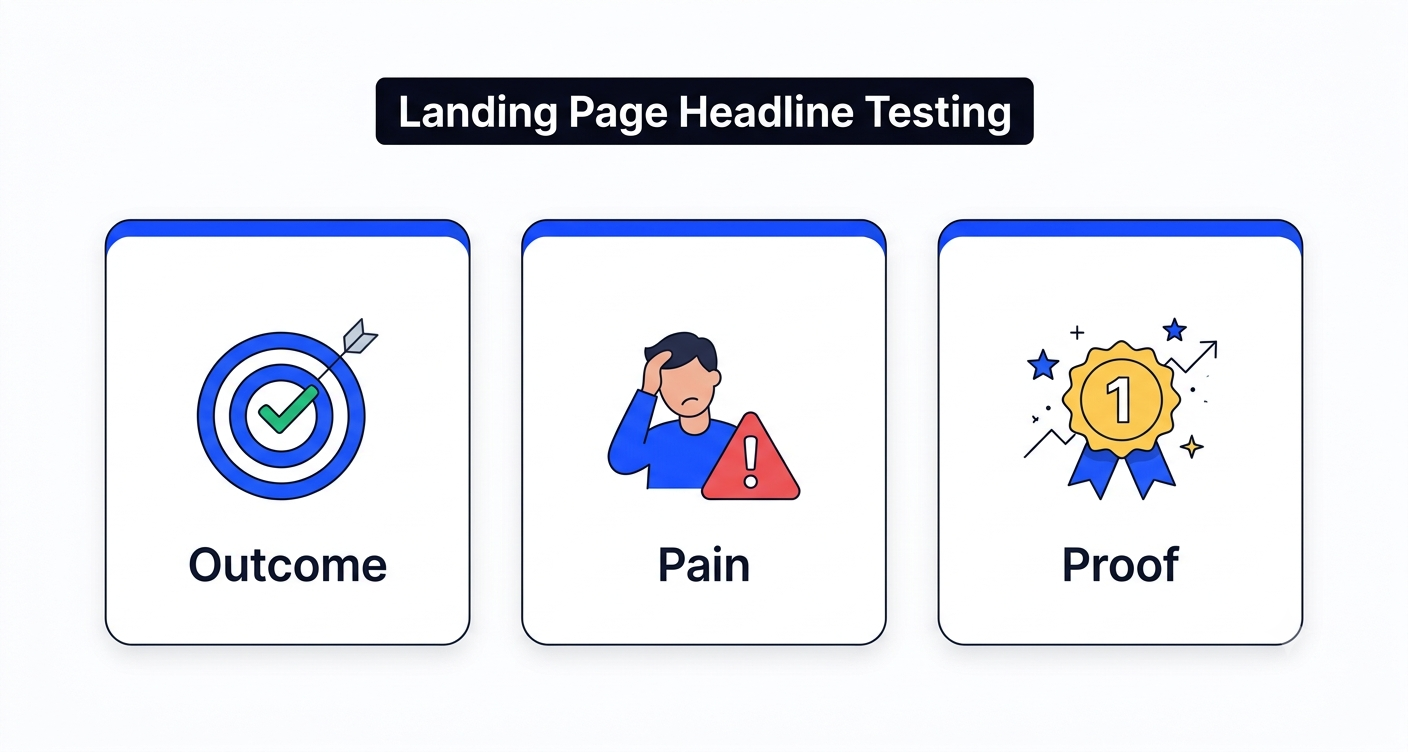
Real landing page headline testing compares different reasons someone might act, not different ways of saying the same reason. After 600+ pages, we've narrowed it down to three starting angles that reliably separate the winner from the noise. Every page we build gets tested against at least two of these three before we optimise anything else.
Why most landing page headline testing fails
The problem isn't lack of testing. It's testing variations instead of alternatives. There's a critical difference, and it's the single biggest reason landing page headline testing produces flat, unreadable results.
Variations are cosmetic changes to the same idea:
- "Get More Leads For Your Business" vs "Generate More Leads Today" vs "Boost Your Lead Generation"
These will produce nearly identical conversion rates because they're saying the same thing to the same motivation. You'll get a 0.2% difference, call one the "winner," and wonder why the page still isn't converting.
Alternatives are different arguments aimed at different motivations:
- "47 clinics across India book patients through this page" (proof)
- "Your receptionist is losing you ₹3 lakh a month in missed calls" (pain)
- "Every call answered, every slot filled, every night — without hiring" (outcome)
These will produce 30–80% differences in conversion rate because they're appealing to different reasons to act. One of them will connect with your specific audience far better than the others. Finding which one is the entire point of landing page headline testing.
The three angles
Every effective headline we've written falls into one of three categories. You don't need to test all three — start with two, find the winner, then optimise within that angle.
| Angle | What it does | Works best when |
|---|---|---|
| Outcome | Describes the result they'll get | The buyer knows what they want but hasn't found it |
| Pain | Names the problem they're living with | The buyer is frustrated and looking for relief |
| Proof | Shows that others have already done it | The buyer is considering you but doesn't trust yet |
Angle 1: The outcome headline
This headline describes what the buyer's life looks like after they use your product or service. It doesn't mention the product — it mentions the result.
The formula: [Specific result] + [for whom] + [without the usual downside]
Examples from real pages we've built:
- "Pages that turn ad clicks into booked calls" (landing page service)
- "Every enquiry answered, quoted and booked — while your team sleeps" (AI agent)
- "Trial sessions booked before parents leave the parking lot" (youth sports academy)
Why it works: the buyer sees their desired future, not your service description. "We build landing pages" is about you. "Pages that turn ad clicks into booked calls" is about them. That reframe is why outcome headlines consistently outperform feature headlines by 20–40% in our tests.
When it fails: when the outcome is too vague. "Grow your business" is technically an outcome but it's so generic it means nothing. The specificity is what makes it work. "Booked calls" is better than "more leads." "₹3 lakh in recovered revenue" is better than "better ROI."
Angle 2: The pain headline
This headline names the problem the buyer is currently living with. It doesn't offer a solution yet — it demonstrates that you understand their situation precisely enough that you're worth listening to.
The formula: [The specific frustration] + [its measurable cost]
Examples from real pages:
- "Your receptionist is losing you patients every time she puts someone on hold" (dental clinic)
- "You're spending ₹50,000 a month sending traffic to a page that wasn't built to convert it" (landing page audit)
- "Three vendors, three invoices, nobody accountable for the result" (agency positioning)
Why it works: recognition is one of the most powerful psychological triggers in conversion. When someone reads a headline that describes their exact situation, the implicit message is "this person understands my problem well enough to have solved it." That's more convincing than any claim about your solution.
When it fails: when the pain is too dramatic or too general. "Are you struggling with your business?" sounds like a spam email. "Is your website not working?" is too vague to trigger recognition. The pain has to be specific enough that the buyer thinks "that's exactly what's happening to me right now."
Read your pain headline to someone who matches your buyer profile. If they say "yeah, that's exactly it" — you've found it. If they say "I guess so" — it's too vague. Rewrite with more specificity until you get the first reaction.
Angle 3: The proof headline
This headline leads with evidence that other people — ideally people like the buyer — have already done the thing you're asking them to do. It answers the question "has this worked for someone in my situation?" before the buyer has to ask it.
The formula: [Number or name] + [specific result] + [implied "you can too"]
Examples from real pages:
- "600+ landing pages. 50,000+ appointments booked. Here's the framework." (our own site)
- "47 clinics across India use this system to fill every slot" (clinic automation)
- "This page books 14 consultations a week for a construction company in LA" (landing page)
Why it works: proof reduces perceived risk. The buyer isn't the first person trying this. Other people — in a similar industry, a similar market, with similar doubts — have already done it and gotten a specific result. The headline does the work that a testimonial section does, but in the first three seconds.
When it fails: when the proof isn't credible or isn't relevant. "Trusted by thousands" means nothing because anyone can write it. "14 consultations a week for a construction company in LA" works because it's specific, verifiable, and the reader can picture the business. If you don't have a real number, don't fake one — use a different angle.
The proof headline only works when the proof is real. If you have to round up, generalise, or borrow someone else's numbers to make it work, switch to outcome or pain. Honesty converts better than inflation.
How to run landing page headline testing
You don't need special software to run landing page headline testing properly. Here's the simplest version that gives you a real signal — the same process described in Optimizely's overview of A/B testing methodology, adapted specifically for headlines.
- Pick two angles. Don't test all three at once — you need enough traffic per version to get a meaningful result. Two versions at 200 visitors each is better than three versions at 130.
- Write one headline per angle. Spend the time here. Each headline should be the best version of that angle, not a draft. If your pain headline is weak and your outcome headline is strong, the test is rigged and the result is useless.
- Split your traffic evenly. If you're running Meta ads, duplicate the ad set and point each to a different page version. If you're using a page builder with A/B testing (like Elementor Split Test or Google Optimize), set it to 50/50.
- Run it until you have 200+ visitors per version. Not 200 total — 200 each. At 50 visitors a day, that's eight days. Don't look at the numbers before then. Early results are noise.
- Judge by conversion rate, not by gut. If version A converts at 4.2% and version B at 2.8% after 200+ visitors each, that's a real signal. If the difference is 3.1% vs 2.9%, you need more traffic or a bigger change.
Once you know which angle wins, then test variations within that angle. If the pain headline won, try three different pain headlines. Now you're optimising within a proven frame instead of guessing across frames.
Want us to write the test for you?
We diagnose the offer, write the three angle headlines, and build the test into the page. You see results, not drafts.
Start a page project →Common questions
What if none of the three angles work?
If you've tested two angles with 200+ visitors each and neither converts above 2%, the problem is almost certainly not the headline — it's the offer. A headline can only sell what's behind it. If the offer isn't compelling, the best headline in the world won't save it. We cover this in depth in our post on diagnosing whether it's the ads or the page.
Can I combine angles in one headline?
You can, but it usually weakens both. "47 clinics use this system to fill every slot" is proof + outcome, and it works because the proof carries the outcome implicitly. But "Stop losing patients to missed calls — 47 clinics already fixed this" is pain + proof crammed together, and neither lands as hard. Pick the strongest angle and commit to it.
How often should I change my headline?
Only when you have data saying it's underperforming. A headline that converts at 5% doesn't need changing just because you're bored of it. Your visitors are seeing it for the first time. Change it when the conversion rate drops (which usually means audience fatigue, not headline fatigue) or when you have a genuine alternative to test.
Does headline length matter?
Less than people think. A clear 12-word headline will outperform a vague 5-word headline every time. The constraint isn't word count — it's whether the headline communicates its point in the time someone's willing to give it, which on a landing page is about three seconds. If you need 12 words to be specific, use 12 words. If you can do it in 6, do it in 6.
Rohit Bhatt
Founder, LFC VenturesRohit writes the headlines and runs landing page headline testing on every page LFC Ventures builds. The three-angle framework in this post has been used across 600+ landing pages.