Landing pages
Why your landing page gets traffic but no customers
If your ads are delivering clicks and your sales aren't moving, the problem is almost never the traffic. These are the twelve failure points we find most often when auditing pages already spending real money.
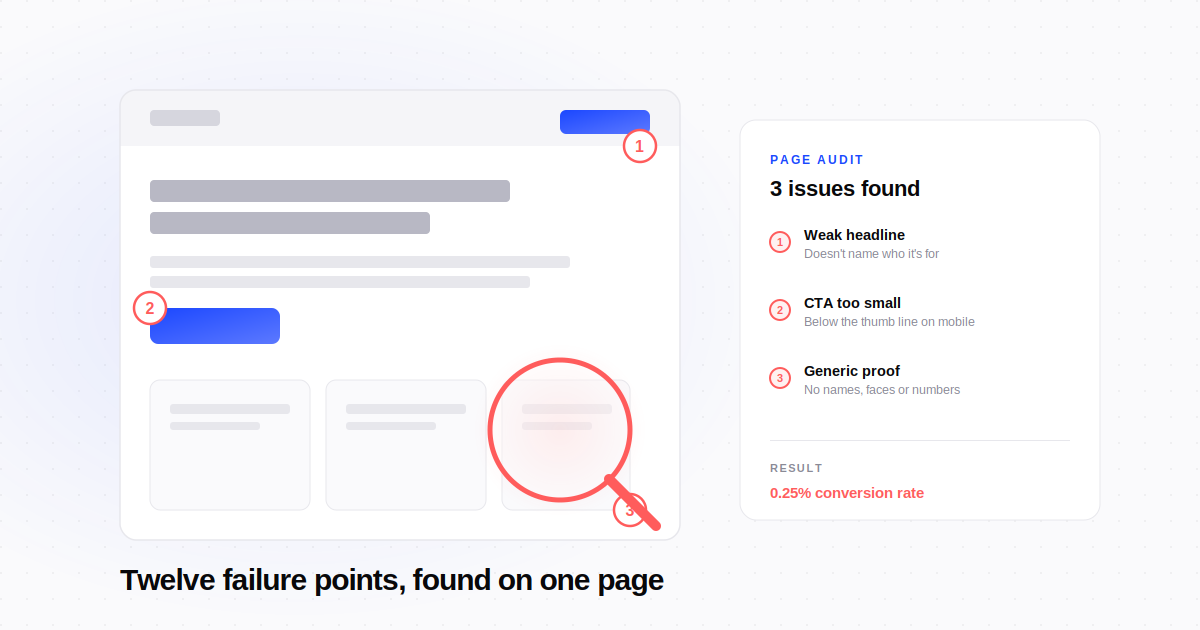
A client came to us last month with a page doing roughly one sale for every fifty-four visitors. Their instinct was that the traffic was wrong. It's the natural conclusion, and it's usually incorrect. We looked at the campaign first, found it healthy, then spent an hour on the page. The problem was on the first screen and had been there since launch.
Diagnose before you design
Before touching a single element, separate two numbers: how many people arrive, and how many take the next step. If your click-through rate is healthy but your conversion rate isn't, no amount of creative testing will help. You're paying to send qualified people to a page that loses them.
Open your page on your phone and set a five-second timer. When it ends, could a stranger say what you sell, who it's for, and what happens next? If not, that's your first fix — and it's worth more than every other change combined.
What the first screen must do
The area visible before anyone scrolls carries almost all of the decision weight. It has exactly three jobs, and most pages attempt only one.
- State the outcome, not the service. "We design websites" is a category. "Pages that turn ad clicks into booked calls" is an outcome someone can want.
- Name the person. A visitor should recognise themselves in the first two lines, or they assume the page is for somebody else.
- Make the next step obvious and small. One primary action, stated as what happens when it's used.
Most pages fail not because they're ugly, but because a visitor can't work out within five seconds whether the page is for them.
The headline test
Read your headline aloud, then ask whether a competitor could put their logo above it without changing a word. If they could, it isn't a headline — it's a placeholder that survived to launch.
Want this run on your page?
We go through the full 30-point framework on a live page together, and you leave with the list in priority order.
Book a session →Why your proof isn't landing
Testimonials fail for a predictable reason: they praise you instead of describing a change. "Great to work with" is a compliment. "We went from twelve enquiries a month to forty-one in six weeks" is evidence. Pair a name, a face, a business and a number where you can — and use fewer testimonials rather than weaker ones where you can't.
This connects to how you structure the rest of the page — see our breakdown of whether you need a landing page or a full website.
Friction you stopped noticing
You've seen your own page four hundred times, so you no longer experience it. What we find in almost every audit:
- Forms asking for information you don't need until later
- Mobile buttons sitting below the thumb line
- Page weight over 3MB, costing you visitors before they see anything
- Two competing calls to action in the same screen
- A required phone field on a page selling a free resource
| Symptom | Usual cause | Where to look |
|---|---|---|
| High clicks, low conversions | Message mismatch | Ad copy vs headline |
| Visitors leave under 10s | Load time or unclear offer | First screen |
| Form started, not finished | Too many fields | Form length |
Common questions
How long before I judge a new landing page?
Wait for enough traffic rather than enough days. Roughly 300–500 visitors gives you a signal you can act on; less than that and you're reading noise.
Should I redesign or rewrite first?
Rewrite. Copy carries the decision, design carries the credibility. Changing the words is cheaper, faster, and tells you whether the offer itself is the problem.
Do video sales letters actually help?
On considered purchases, usually yes — they let you handle objections in sequence. On low-price impulse offers they often slow the page down.
Rohit Bhatt
Founder, LFC VenturesRohit has built 600+ landing pages for founders across India, Australia and Germany, and works on the pages, the campaigns driving them and the automation behind them.