AI automation
AI agent or chatbot? The difference that decides your ROI
One answers questions. The other completes work. Most businesses buy the first and expect the second, then conclude AI doesn't work. Here's how to tell which one you actually need.
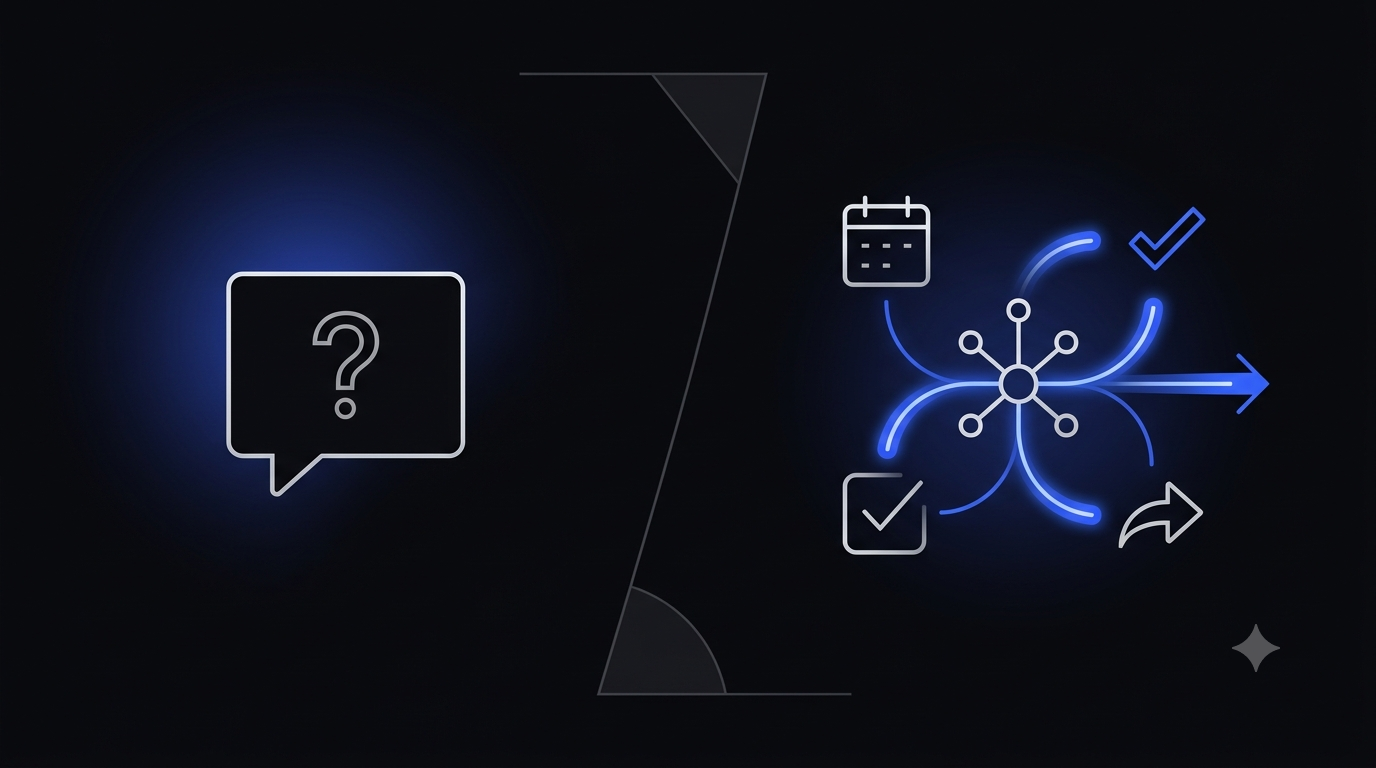
AI agent vs chatbot is the question every business owner should ask before buying either one, and almost nobody does. A business owner hears "AI" and imagines something that handles the work they're drowning in — replying to enquiries, sending quotes, booking appointments, chasing follow-ups. Then they buy a chatbot, spend a few weeks configuring it, and end up with something that says "I'm sorry, I didn't understand that" forty percent of the time. They conclude that AI doesn't work for their business. It does. They bought the wrong kind.
This distinction between an AI agent and a chatbot is not a branding difference. It's an architectural one, and it determines whether the thing you install saves you time or wastes it.
AI agent vs chatbot: the actual difference
A chatbot is a response system. It waits for a message, matches it against a set of rules or intents, and returns an answer. Even the best ones — the ones powered by large language models — are fundamentally reactive. They answer what you ask. They don't do anything about it.
An AI agent is a task-completion system. It receives an input (an enquiry, a phone call, a form submission), interprets what needs to happen, takes action using your business rules, and moves work forward without waiting for a human to approve each step.
| Capability | Chatbot | AI agent |
|---|---|---|
| Answers a question | Yes | Yes |
| Looks up live data | Sometimes | Yes — calendars, stock, CRM |
| Applies pricing rules | No | Yes — your logic, your rates |
| Books an appointment | Links to a booking page | Checks availability, books, confirms |
| Sends a quote | No | Calculates and sends it |
| Qualifies a lead | Asks scripted questions | Scores against your criteria and routes |
| Handles a phone call | No | Yes — voice, real-time |
| Works across time zones | Technically yes, practically no | 24/7 with no shift handover |
If what you need is "answer frequently asked questions on my website," a chatbot is fine. If what you need is "do the thing the customer is asking about," you need an agent.
Why chatbots disappoint
Chatbots fail for a specific, predictable reason: the person using them doesn't want an answer — they want an outcome. And the gap between those two things is where the frustration lives.
The dental clinic example
A patient messages: "Do you have anything Saturday morning?" A chatbot replies: "We're open Saturdays from 9am to 1pm. You can book an appointment through our website." The patient now has to navigate to a booking page, find Saturday, pick a slot, and fill in their details. Three of those four steps are unnecessary — the system already knows the availability.
An agent replies: "We have 9:30 or 11:15 with Dr. Rao. Which works?" The patient says "9:30" and gets a confirmation text. The task is done. No booking page, no form, no drop-off.
The airport transfer example
A customer messages: "Need a pick-up at Delhi T3, 10 August, 2 PM, four bags." A chatbot might say: "We offer sedan, SUV and minivan options. Please visit our booking page for pricing." An agent reads "four bags," knows a sedan can't fit them, checks the pricing table, and replies: "Sedan won't fit four bags — SUV is ₹2,450, 45 minutes from your area. Confirm?" The customer says yes. The booking is made.
The agent didn't just understand the request. It reasoned about luggage capacity, selected the right vehicle, priced the route, and completed the booking. That's not a chatbot doing more — it's a fundamentally different system. See the full story in how an airport transfer company stopped quoting by hand.
A chatbot tells people where to find the answer. An agent gives them the outcome.
What an AI agent actually does
An agent connects to your business systems and operates under rules you define. The rules aren't suggestions — they're constraints. The agent cannot override your pricing, cannot book outside your availability, and cannot make promises you haven't authorised.
Here's what that looks like in practice across different business types:
- Service businesses — reads enquiries on WhatsApp, web chat or email, asks qualifying questions if needed, applies your pricing logic, sends a quote, and books the job. Your team sees the booking, not the conversation.
- Clinics and practices — answers phone calls (voice, not text), checks live calendar availability, offers slots, books the appointment, sends an SMS confirmation and a reminder the day before. Reception sees a filled calendar, not a list of missed calls.
- E-commerce and D2C — handles post-purchase questions (where's my order, how do I return this), processes straightforward returns against your policy, and only escalates exceptions to a human.
- Real estate — qualifies portal leads against budget, location, and timeline, scores them, and routes only genuine buyers to an agent. Everyone else gets nurtured automatically.
- Multi-market operators — handles enquiries across time zones so nothing sits unanswered overnight. The business in India answers the Australian customer at 3 AM IST without anyone waking up.
Which one you need
Answer these three questions honestly:
- What happens to an enquiry that arrives at 11 PM? If the answer is "nothing until tomorrow," you need an agent. A chatbot will acknowledge the message but won't move the work forward, and by morning the customer has contacted your competitor.
- Does your team do the same steps in the same order more than ten times a day? If yes, that's an agent's job. Reading an enquiry, checking a calendar, applying a price, sending a confirmation — if the logic is consistent, a human shouldn't be doing it.
- Is the bottleneck information or action? If people can't find your phone number or opening hours, a chatbot and a better FAQ page will fix it. If people know what they want and your team can't process it fast enough, you need something that completes the task.
Not everything needs an agent. If your business gets fifteen enquiries a day and they're all different, a well-briefed human is still better. Agents excel at volume and repetition. If you handle forty identical quoting requests a day, the ROI is obvious. If you handle four complex ones, it usually isn't.
Not sure which one fits?
Tell us what your team does every day. If it repeats and follows rules, there's usually a build worth scoping. If it doesn't, we'll tell you that too.
Talk to us about agents →What it costs and what it takes
Chatbots
A decent chatbot can be set up in a week for ₹10,000 to ₹50,000 using tools like Tidio, Intercom, or Drift. Monthly costs are typically ₹2,000 to ₹15,000 depending on volume. The limitation isn't cost — it's capability. You'll hit the ceiling fast if your customers expect outcomes rather than answers.
AI agents
A custom agent build takes three to six weeks and is scoped per project. The cost depends entirely on what it needs to connect to (your CRM, your calendar, your pricing system, your phone line) and how many rules it operates under. It's meaningfully more expensive than a chatbot, but the comparison isn't fair — you're replacing a portion of a salary, not a software subscription.
The honest test: if the agent replaces work that currently costs you ₹30,000 or more per month in staff time (or lost enquiries), the ROI is usually clear within sixty days. If it replaces ₹8,000 of work, it probably isn't worth building.
Common questions on AI agent vs chatbot
Can a chatbot be upgraded into an agent?
Not really. It's a different architecture. A chatbot is a conversation layer; an agent is a workflow engine that happens to have a conversation interface. You'd be rebuilding from scratch rather than upgrading, so it's better to start with the right one.
Will customers know they're talking to AI?
Most will assume it, and you should be transparent about it. What matters isn't whether they know — it's whether they care. If the agent books their appointment in thirty seconds at midnight, they care less about who (or what) did it than about the fact that it's done.
What if the agent makes a mistake?
Agents operate under your rules, and rules have boundaries. When a request falls outside those boundaries — an unusual pricing scenario, a complaint, a question the agent wasn't built for — it escalates to a human with full context. The failure mode isn't "wrong answer." It's "I need to hand this to someone." That's by design.
Do I need to change my existing tools?
Usually not. Agents integrate with what you already use — Google Calendar, WhatsApp Business, your CRM, your booking system. The build connects to your stack rather than replacing it. If your tools are genuinely too old to connect to, we'll flag that in the scoping call before any money changes hands.
Rohit Bhatt
Founder, LFC VenturesRohit builds and deploys AI agents for service businesses across India, Australia and multi-market operators. The AI agent vs chatbot examples in this post are based on systems his team has built and maintains.